May 22, 2026
AI companies are doubling SDR headcount
Yesterday, I got a cold call from an SDR at a software company I worked at for over a decade. His first question? “How did you hear about us?”
The rep had no idea who he was calling. I am actually a buyer for this product right now. But that single question told me everything I needed to know about how that company runs its pipeline.
Compare that to a cold email I got last week from a real estate rep wanting to manage a vacation property I own. He didn’t just pull a list off AirDNA. He dug into state business filings to unmask the owner behind the property’s LLC, cross-referenced my name to find my primary C-Corp, saw I’d recently launched an AI company, and checked the property’s performance data against local benchmarks. He connected three disparate data sources before he ever hit send.
I took that call. He was right, the property is underperforming. And he’ll probably win my business. Same job. Completely different outcome. The only variable was preparation.
New hiring data shows that overall GTM job posts are down 15% heading into H1 2026, with SDR/BDR roles specifically down 21% year over year. If you’ve been following the “AI will replace your SDRs” narrative, this feels like confirmation.
Except it isn’t.
AI-native companies more than doubled their SDR headcount over the same period. The companies building the tools that supposedly make SDRs obsolete are hiring them faster than anyone else. That is not a coincidence. That is a signal.
Why the creators of AI are hoarding SDRs
The companies building the future of AI aren’t hiring SDRs to act as human data-scrapers. They’ve automated the grunt work.
Their SDRs operate like air traffic controllers routing high-intent revenue, not data entry clerks hunting down phone numbers. Because their reps run on an AI-native stack, an individual seller can handle five times the pipeline volume of a traditional legacy team.
The problem with the rest of the market isn’t headcount. It’s operational friction.
The 4.3% sales bottleneck
We like to think sales tech is cutting-edge, but the reality is bleak.
According to Anthropic’s February 2026 data on real-world AI agent usage, software engineers have completely re-architected their day-to-day around automation—accounting for a massive 49.7% of all agent activity.
Sales and CRM? A rounding error at just 4.3%.

Engineers build systems; sales leaders buy individual tools. Because of that, your reps are losing 90 minutes every single day just context-switching and clicking between disparate tabs to figure out who they are talking to. They aren’t underperforming because they’re lazy; they’re underperforming because…
They are working for the AI instead of the other way around.
Stop building sales tools with scotch tape and glue
When growth teams realize their data pipeline is broken, they usually make a classic Series A/B mistake: they try to DIY a solution. They buy Clay or Apollo, hook it up to n8n, write some Zapier webhooks, and try to pipe it into Salesforce.
On their own, these are excellent, user-friendly tools. That’s exactly how the trap snaps shut.
The problem isn’t the individual software; it’s the stitching. The moment you chain four different point-solutions together to handle data, you are building custom corporate infrastructure.
Without meaning to, you’ve just created a textbook Shadow IT nightmare. A tech-savvy rep builds a brilliant patchwork system that everyone suddenly relies on to hit their numbers. But because it’s stitched together with digital duct tape, your revenue engine becomes incredibly fragile:
Massive configuration debt: The exact moment a vendor tweaks an API or a webhook misfires, the entire chain drops and leads die on the vine.
A single point of failure: The second your tech-savvy builder leaves the company, nobody else knows how the maze works. Your pipeline shouldn’t grind to a halt just because an employee changed jobs.
A crime scene for IT: When that custom maze inevitably breaks, IT is expected to debug and fix a ghost-stack they never approved, don’t own, and can’t secure.
A Sales Leader doesn’t want to manage a brittle software project, and an IT leader doesn’t want to support one.
Moving software out of the dashboard and into the workflow
Every software vendor promises their dashboard is “intuitive.” But your reps don’t want another destination. They want their tools to live where they already live.
Right now, your reps are spending hours a day inside ChatGPT, Claude, and Gemini to write emails, brainstorm angles, and analyze notes. So why are we forcing them to leave those windows to find pipeline data?
We built YouEx.ai to completely change where sales software operates. Through native MCP integration, YouEx.ai bridges the gap between your core CRM data and the AI models your team uses every single hour.
When your AE opens Claude or ChatGPT to prep for an upcoming enterprise demo, they don’t go digging through Salesforce. They simply ask the model.
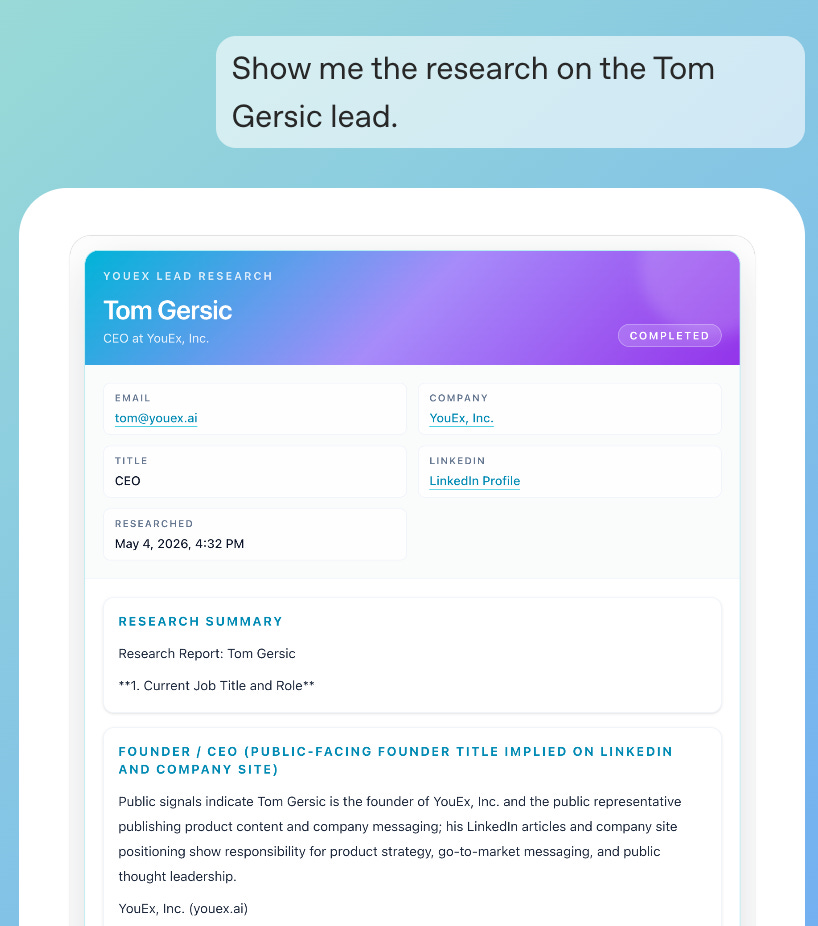
Because YouEx.ai runs natively via MCP behind the scenes, the LLM instantly surfaces the prospect’s real-time tech stack, recent funding history, and deep corporate entity matches. The AI isn’t a separate app to context-switch into; it’s an informed partner that already has the full, high-fidelity context of the lead before the rep even types a prompt.
Out of the box. Zero glue code.
You don’t need a dedicated data engineering team, and you don’t need to risk a fragile setup that breaks next month.
YouEx.ai gives you a complete lead-to-revenue workflow—capture, enrich, score, route, nurture, track, and convert —fully integrated into the chat interfaces your team already loves.
Stop making your reps work for their data. Bring the data to your reps.
Twenty seconds of research changes everything. See what it looks like when your whole team runs that way. Start free at https://youex.ai/free-trial