July 7, 2026
The EU AI Act Is the Baseline for AI Sales Agents. Customer Trust Sets the Standard.
Nobody in the US asked for the cookie acceptance banners we all click everyday. Nor did US voters ask to make EU privacy law part of our websites, sales processes, vendor reviews, and data-processing paperwork. And yet, here we are. It’s a global economy, so GDPR and ePrivacy Directive (the “EU cookie rule”) still became operational facts for companies that wanted European customers and websites that have European visitors. Market access has a way of turning foreign regulation into product requirements.
The EU AI Act is about to do the same thing for AI agents.
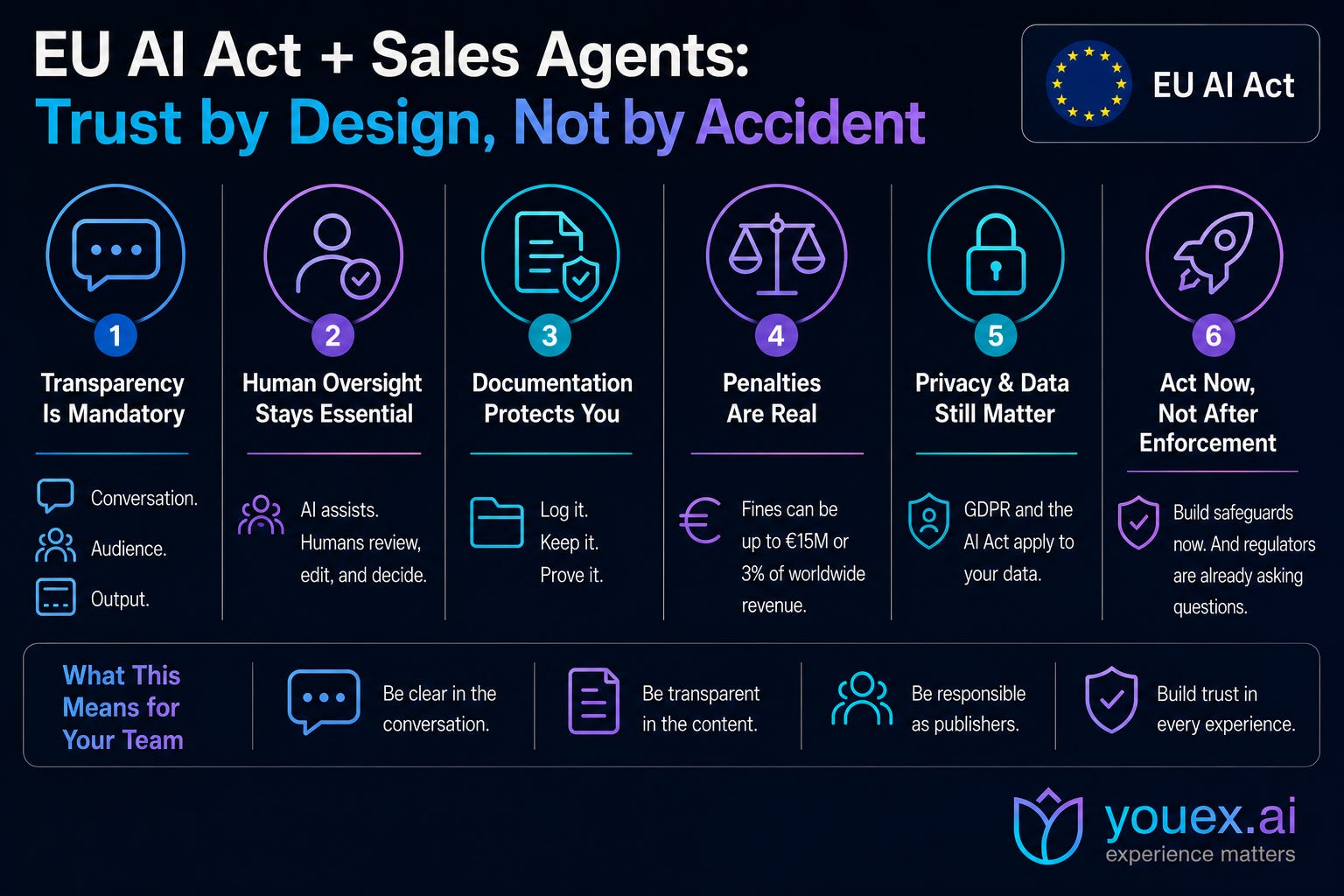
If you build or use AI tools for sales, the important question isn’t “are we based in Europe?” The real question is “will this system be used by people in the EU?” If the answer is yes, the Act belongs in your product and compliance planning, even if your company is not located in the EU. [1]
For GTM tools like YouEx.ai, the starting point is Article 50: the Act’s transparency rulebook. Most of these obligations start applying on August 2, 2026. And while the EU recently moved some of the higher-risk AI deadlines, it didn’t make the transparency. rules disappear. [2]
The lesson from GDPR and cookies shouldn’t be “add another banner.” This is the worst version of compliance: technically compliant and user-hostile. AI transparency should be better than that:
When an AI system is acting as an agent, people should know.
When it generates content, provenance shouldn’t vanish.
When a customer asks how something was produced, they should get a good answer.
That’s the real lesson of the EU AI Act for sales technology: the regulation tells you where the minimum starts. Customer trust tells you what credible looks like. Customers still want to know what the agent disclosed, what it generated, which model produced the output, whether the system was tested for prompt injection, whether behavior is logged, and whether someone is monitoring the agent after launch. Those aren’t just legal questions. They’re product questions, security questions, admin questions, renewal questions, and trust questions.
First off, does this even apply to you? Probably!
Much like GDPR, the AI Act’s reach doesn’t stop at the EU border.
It applies to providers that place AI systems in the EU market, service users in the EU, or if the output produced by that AI system is used in the EU. [1]
For U.S. sales teams, that’s enough to matter.
Check your compliance here: EU AI Act Compliance Checker
Where sales tech fits
The Act is risk-based. At a high level, it sorts AI into prohibited practices, high-risk systems, systems with specific transparency obligations, and everything else.
The high-risk list is specific. Article 6 and Annex III cover areas like biometrics, critical infrastructure, education, employment and recruitment, access to essential services, creditworthiness, certain insurance uses, law enforcement, migration and border control, and administration of justice and democratic processes. [3]
An AI agent that researches accounts, enriches leads, drafts outreach, and helps a rep prepare for a meeting isn’t typically considered a high-risk system, but the line can move. The same underlying AI platform can qualify as high-risk if it’s marketed, configured, or repurposed for HR use cases like recruitment or candidate evaluation. Employment and candidate selection are explicitly listed in Annex III. [4]
Article 50.
For sales AI, the section that applies is mostly Article 50. But Article 50 is broad. It’s not just one rule that says “tell people they’re talking to AI.”
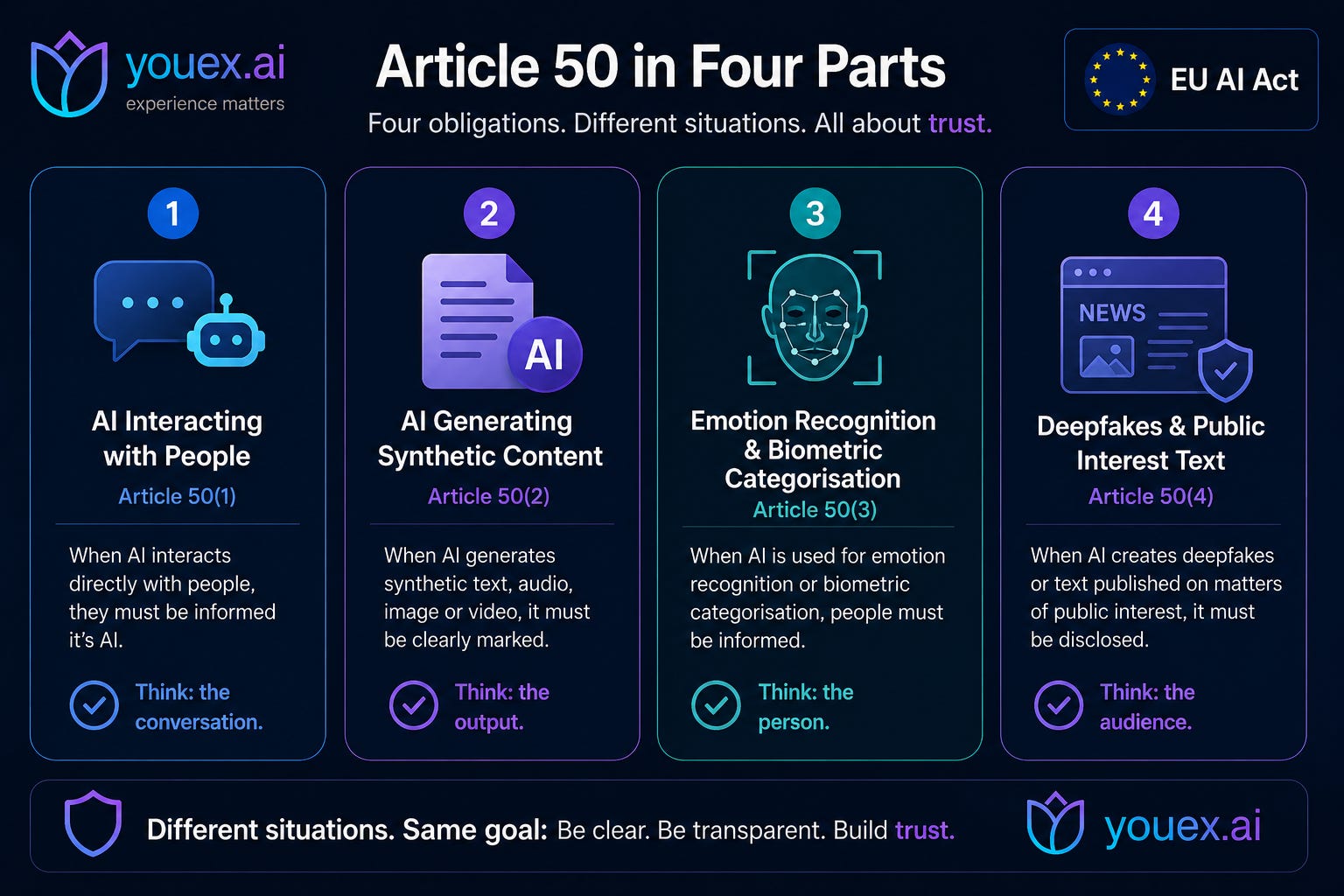
There are three pieces that are relevant:
1. Interaction disclosure
Article 50(1) says providers must ensure that AI systems intended to interact with people are designed and developed so that people are told they’re interacting with AI, unless that’s already obvious from the circumstances. [5]
If an AI agent is directly chatting with a prospect, emailing a person autonomously, or otherwise interacting with a natural person as the agent, Article 50(1) applies and the disclosure needs to live where the interaction happens.
2. Machine-readable marking.
Article 50(2) says providers of AI systems, including general-purpose AI systems, that generate synthetic audio, image, video, or text content must ensure the outputs are marked in a machine-readable format and detectable as artificially generated or manipulated, subject to important exceptions. [5]
A machine-readable mark is about provenance and detectability. It doesn’t necessarily mean every sales email has to open with “This was written by AI.” The easy mistake is to treat Article 50 as one big “AI disclosure” rule. It’s not.
Part 1 is about the interaction: if an AI agent is talking to a person, that person may need to know it’s AI. Part 2 is about the output: if the system generates content, provenance may need to travel with it.
3. Biometric Categorization
Article 50(3) says deployers of emotion recognition or biometric categorization systems have to inform the natural persons exposed to the system. But if you’re actually in emotion-recognition territory, disclosure may not be the whole story. The Act also classifies emotion recognition systems as high-risk when they’re not otherwise prohibited, and it bans AI systems used to infer emotions in workplace and education contexts except for medical or safety reasons.
Article 50(3) doesn’t typically apply to ordinary sales intent scoring. A lead score based on firmographics, engagement, CRM activity, website behavior, or the text of a prospect’s reply isn’t the same thing as emotion recognition.
The line changes when the system starts reading biometric signals: face, voice, eye movement, posture, or similar data. If a tool scores whether a prospect is interested, skeptical, frustrated, or ready to buy based on those signals, you’re no longer just doing sales intent. You may be in emotion-recognition or biometric-categorization territory.
4. Deepfakes and Public-interest
If you use AI to generate text that’s published to inform the public on matters of public interest, you may need to disclose that it was AI-generated. Think public reports, news content, civic information, or other material meant for a broad audience.
If a rep uses AI to draft an email, reviews it, edits it, and sends it to a prospect, that usually isn’t a public-interest publication. It’s private business correspondence. The Act also gives room for human review and editorial control, which is another reason a reviewed sales email isn’t the obvious target of this rule.
So the practical takeaway is simple: If AI is publishing public-facing content, disclose when required.
What it costs to get wrong.
For larger companies, Article 50 violations can result in administrative fines of up to €15 million or 3% of worldwide annual revenue, whichever is higher. For startups and SMBs, the cap is lower: the lesser of €15 million or 3% of revenue. Regulators are also required to consider the economic viability of SMEs and startups when determining penalties. That makes the penalties more proportionate, but not painless.
Legal minimums don’t create customer trust.
The real forcing function for AI sales tools should be the customer. The customer’s security team will ask how the agent handles data. Legal will ask what the system discloses. Sales leadership will ask whether reps can trust the output. RevOps will ask whether the workflow is logged. Admins will ask what happens when something breaks. And the people receiving AI-assisted outreach will judge whether the interaction feels honest or deceptive.
That’s why the high-risk rulebook still matters. Article 9 requires high-risk systems to have a risk management system. Article 10 requires data governance and bias controls for high-risk systems trained with data. Article 12 requires record-keeping and automatic logging. Article 15 requires appropriate accuracy, robustness, and cybersecurity. [10]
Those provisions may not legally apply to a sales agent, but they describe the evidence that customers increasingly expect from any AI system acting on their behalf.
Because customer trust doesn’t come from saying “we’re compliant.” It comes from being clear, predictable, and honest about what the system is doing.
What did the agent disclose?
What did it generate?
Which model produced the output?
What data did it use?
What guardrails were tested?
What happens when the model changes?
Who owns the workflow when something goes wrong?
This gets harder when an “AI Sales Stack” is eight tools in a trench coat
Does your AI Sales Tech stack make for an engaging infographic? A CRM here. An enrichment vendor there. A workflow platform gluing it together. A browser agent reading public pages. A general-purpose model drafting copy. Another tool sending the message.
Which model produced this output? Nobody knows.
Who tested the full chain? Great seller. She left the company a few months ago.
Where’s the audit trail? Spread across five vendors, three dashboards, and one Slack thread.
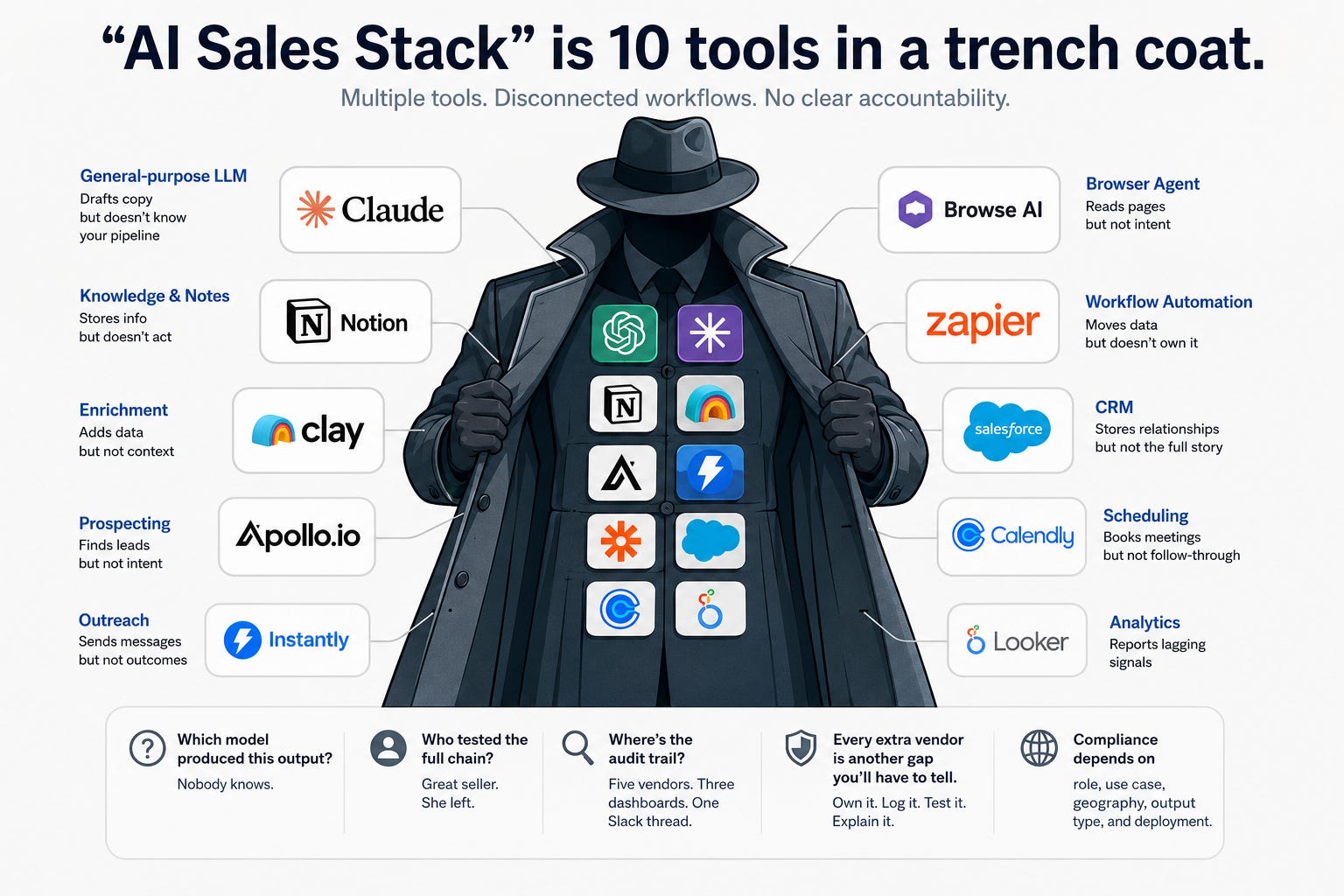
Every extra vendor in the stack is another gap in the story you’ll have to tell. That doesn’t mean every workflow has to collapse into one product. It does mean someone needs to own the chain, log the chain, test the chain, and explain the chain.
Compliance depends on role, use case, geography, output type, and deployment.
The credible version is specific and harder to fake:
Here’s what we disclose.
Here’s what we mark.
Here’s what we log.
Here’s how we test.
Here’s what we monitor.’
Here’s what you still own as the deployer.
That’s the standard customers actually trust.
How we’re approaching it at YouEx.
That last sentence is the standard we hold the YouEx.ai web agent to. Our goal is customer trust.
AI shouldn’t make work feel colder, weirder, or more bureaucratic. It should make the experience smoother. It should help people move with more confidence. And when the system is powerful, the product has to be even clearer.
Design disclosure into the experience.
Where the agent directly interacts with a natural person, we design for Article 50(1)-style disclosure. The point isn’t to hide AI involvement in a terms-of-service page nobody reads. The point is to make the disclosure understandable where the interaction happens.
Treat generated-text marking as a product requirement.
Article 50(2) is provider-side, and it’s easy to miss. That means analyzing which outputs are synthetic text, which outputs are internal drafts, which outputs materially change user input, and where machine-readable marking or detectability should apply.
Watermarking images is trivial with Google SynthID. Watermarking text in a way that is compliant with the act is actually somewhat of an open question.
OpenAI’s documentation skips over text watermarking entirely: https://openai.com/index/supporting-eu-trustworthy-ai-ecosystem/
Sean Goedecke has a good analysis on why this is non-trivial:
https://www.seangoedecke.com/text-ai-watermarks/
We’re also tracking the Commission’s Code of Practice on transparency of AI-generated content, published June 10, 2026. The Code is voluntary, but the underlying Article 50 requirements aren’t. [11]
We log the model and version.
Every agent action should have a record of the model and version behind it, and that record should travel with the output. When someone asks, “How was this produced?” the answer shouldn’t be a shrug. It should be a trace.
That also lets us connect behavior changes to actual system changes. If output quality shifts after a model update, we shouldn’t be arguing about vibes. We should be looking at the record.
We red-team before we ship.
Articles 9 and 15 put risk management and robustness obligations on high-risk providers. We use the same discipline voluntarily.
We test the agent against prompt injection, jailbreaks, data leakage, unsafe tool use, and off-policy output before release.
That maps to the OWASP Top 10 for LLM Applications and the NIST AI Risk Management Framework: identify the failure modes, test for them, mitigate them, and keep doing it as the system changes. [13][14]
We monitor in production.
Pre-launch testing doesn’t catch everything. Agents drift because models change, tools change, websites change, user behavior changes, and edge cases show up only after deployment.
So we trace live agent behavior and provide tools for our customers to monitor output quality in production. The goal is simple: catch the pattern before your user does.
Let’s be honest
We can’t make your use of AI compliant in the abstract. Neither can any other vendor, no matter what the badge says.
The Act allocates obligations by role and use case. Providers have provider-side duties, including Article 50 design and marking obligations where they apply. Deployers have their own duties, including AI literacy and use-side Article 50 disclosures where their deployment triggers them. [5][9]
What we can give you is the evidence underneath all of it: logs, disclosures, marking decisions, testing, monitoring, and ownership of the chain.
That’s the difference between a vendor saying “trust us” and a system that can show its work.
For an agent that already behaves like the answer matters, you know where to find us.
Sources
EU AI Act, Article 2 — scope, including providers placing systems on the EU market and third-country providers/deployers where output is used in the EU.
EU AI Act, Article 113 — general application from August 2, 2026, with phased dates for certain chapters and obligations.
EU AI Act, Article 6 and Annex III — high-risk classification and listed high-risk areas, including biometrics, critical infrastructure, education, employment, essential services, law enforcement, migration, and justice/democratic processes.
EU AI Act, Article 25 — responsibilities along the AI value chain when a distributor, importer, deployer, or third party modifies intended purpose so a system becomes high-risk.
EU AI Act, Article 50 — interaction disclosure, machine-readable marking for synthetic content, and deployer disclosure duties for deepfakes and certain public-interest text.
European Commission draft Article 50 transparency guidelines, May 2026 — draft guidance on transparency obligations, including AI agents and in-context disclosure.
Council of the European Union, Digital Omnibus / AI Act simplification, June 29, 2026 — new high-risk application dates and December 2, 2026 deadline for provider transparency solutions for artificially generated content.
EU AI Act, Article 99 — penalties, including the €15 million / 3% tier for Article 50 violations, €35 million / 7% tier for prohibited practices, and SME/startup proportionality rules.
EU AI Act, Article 4 and Article 113 — AI literacy obligations and the February 2, 2025 application date for Chapters I and II.
EU AI Act, Articles 9, 10, 12, and 15 — high-risk risk management, data governance, logging, accuracy, robustness, and cybersecurity requirements.
European Commission Code of Practice on Transparency of AI-Generated Content, June 10, 2026 — voluntary code supporting Article 50 marking and labelling obligations; Article 50 remains legally binding.
OpenAI / Promptfoo announcement, March 2026 — OpenAI’s announcement that it would acquire Promptfoo, including Promptfoo’s open-source CLI and library for evaluating and red-teaming LLM applications.
OWASP Top 10 for LLM Applications 2025 — application security risks including prompt injection and sensitive information disclosure.
NIST AI Risk Management Framework 1.0 — voluntary framework for managing AI risks and promoting trustworthy and responsible AI development and use.
Langfuse documentation — open-source tracing and observability for LLM applications.
GDPR, Article 3 — territorial scope for non-EU controllers and processors offering goods or services to people in the EU or monitoring their behavior.
ePrivacy Directive, Article 5(3) — cookie/storage consent framework and the strictly necessary exception.