June 28, 2026
Why your CRM Sucks and Your Reps Hate It
It’s the 28th day of the month, near the end of the quarter. Somewhere on your team, a rep has fourteen tabs open and is reconstructing three weeks of activity from memory, a calendar, and a low hum of dread. Deal stages get nudged forward. Notes get backfilled. “Good call, following up” lands in six records that each deserved a paragraph. Then it’s done, the dashboard turns green, and everyone agrees to treat the pipeline as real.
That rep isn’t lazy. Actually, she’s a great seller. She hit 118% of quota last quarter. We should be rewarding her. The problem isn’t her discipline. It’s the system you handed her, and the fact that it was never built for her productivity in the first place.
The friction is the product
Let’s be honest, most CRMs were sold to managers and IT teams and built for reporting. The buyer was a VP who wanted a dashboard. The user was a rep who wanted to sell. Those are not the same person, and the software was built for the first one. Here's the punchline: it doesn't even work for the VP. A dashboard is only as good as what's behind it, and what's behind it is whatever the rep gets around to entering at month-end. The VP wanted visibility and got a green light wired to a fuel gauge nobody fills. So the rep loses time, the VP loses the truth, IT gets blamed for poor data quality, and the one thing the system was actually designed to produce, a trustworthy view of the business, is the thing it fails at worst.
So out come the spreadsheets…

We’ll just call the spreadsheet a “dashboard”, cool? It’s too complicated to update manually, so Finance will hire an intern to update it each month. The account notes that actually matter live in the rep's head. The CRM you're paying for becomes a system of record for data nobody believes. You bought a single source of truth and built a shadow stack around it.
You can see it in how the time gets spent. According to Salesforce’s State of Sales and a Forrester study of more than 3,000 reps, the average seller spends only about 28% of the week actually selling. Roughly 17% of the week goes to CRM data entry and hygiene. A third of reps spend more than an hour a day just feeding the machine. None of that is calls, demos, or closing. It’s clerical work in a tool that bills itself as a sales tool.
The tool fights you the whole way. Logging one call is five to seven clicks and about ninety seconds on a good day: find the contact, open the deal, click into activities, pick the type, write the summary, save.
🤪 But wait… blocked by a validation rule! 🤪
Multiply by fifteen calls and you have lost twenty minutes to navigation alone. Then a required field blocks the save until you pick a “Lead Source” from a dropdown of fourteen options, half of which don’t apply.
Here’s the part most admins miss: validation rules and mandatory fields don’t produce good data. They produce avoidance. Every blocked save teaches the rep the same lesson, which is that the system wasn’t designed for her. So she stops fighting it. The record stays blank, or it gets a garbage value chosen to make the error message go away. Friction does not improve your data. It just moves the gap somewhere you can’t see it.
It’s a filing cabinet, not an assistant
Strip away the branding and ask what a typical CRM actually does for the rep on a Tuesday afternoon. It stores things. It coordinates the team. It generates the report your VP opens on Wednesday morning. Those are real jobs and they matter. But notice who they serve. The rep does the work of entering the data, and the value of that data flows to forecasts, dashboards, and board slides that don’t help close the deal.
That is the whole adoption problem in one sentence. You are asking people to do clerical work whose only beneficiary is somebody else. So they don’t.
The numbers are brutal and consistent. User adoption is the single biggest cause of CRM failure, and depending on whose study you read, somewhere between half and seventy percent of CRM projects fail to meet their objectives. Fewer than 40% of deployments ever reach 90% end-user adoption. Forbes found that 48% of sales leaders say their CRM doesn’t even meet their needs. The software gets bought, rolled out, trained on, and then quietly abandoned in favor of a spreadsheet and a good memory.
Which brings us back to the 28th of the month. When a system only gets fed at deadline, it isn’t a tool. It’s a lagging report assembled under duress. It tells you where you were, badly, weeks after it could have mattered.
And that is why you’re flying blind
Here is where the friction comes home to roost. A CRM is only as good as the data in it, and the data is a disaster.
Three out of four CRM users say less than half of their organization’s data is accurate and complete. It doesn’t even need a rep to neglect it: B2B contact data decays on its own at roughly 22% to 30% a year, about 2% a month, as people change jobs and companies get acquired. The average B2B contact changes roles every eighteen months. Layer stale data on top of inconsistent entry and you get a pipeline where an estimated 30% to 40% of deals are phantom or dead, sitting there inflating your coverage ratio and lying to you about the quarter.
So it should surprise no one that 67% of enterprise revenue leaders say they do not trust the forecasts that come out of their own CRM. Gartner puts the cost of poor data quality at an average of $12.9 million a year. That is the bill for a system that punishes the people responsible for keeping it accurate.
What we built instead
We started YouEx.ai from the opposite premise: the rep is the customer, not the obstacle. If the person doing the work doesn’t want to use the system, nothing downstream is real. So we attacked the friction directly, in four places.
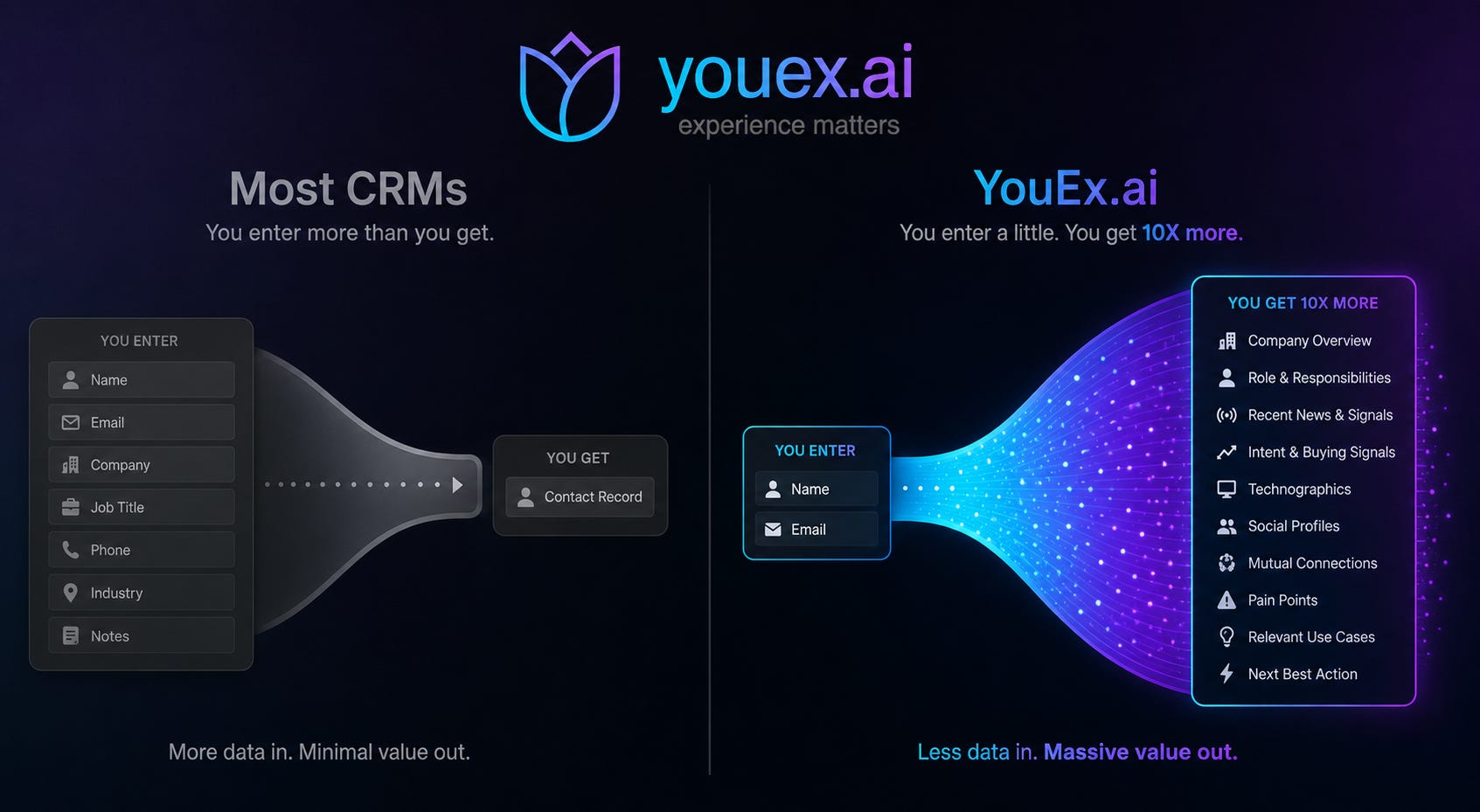
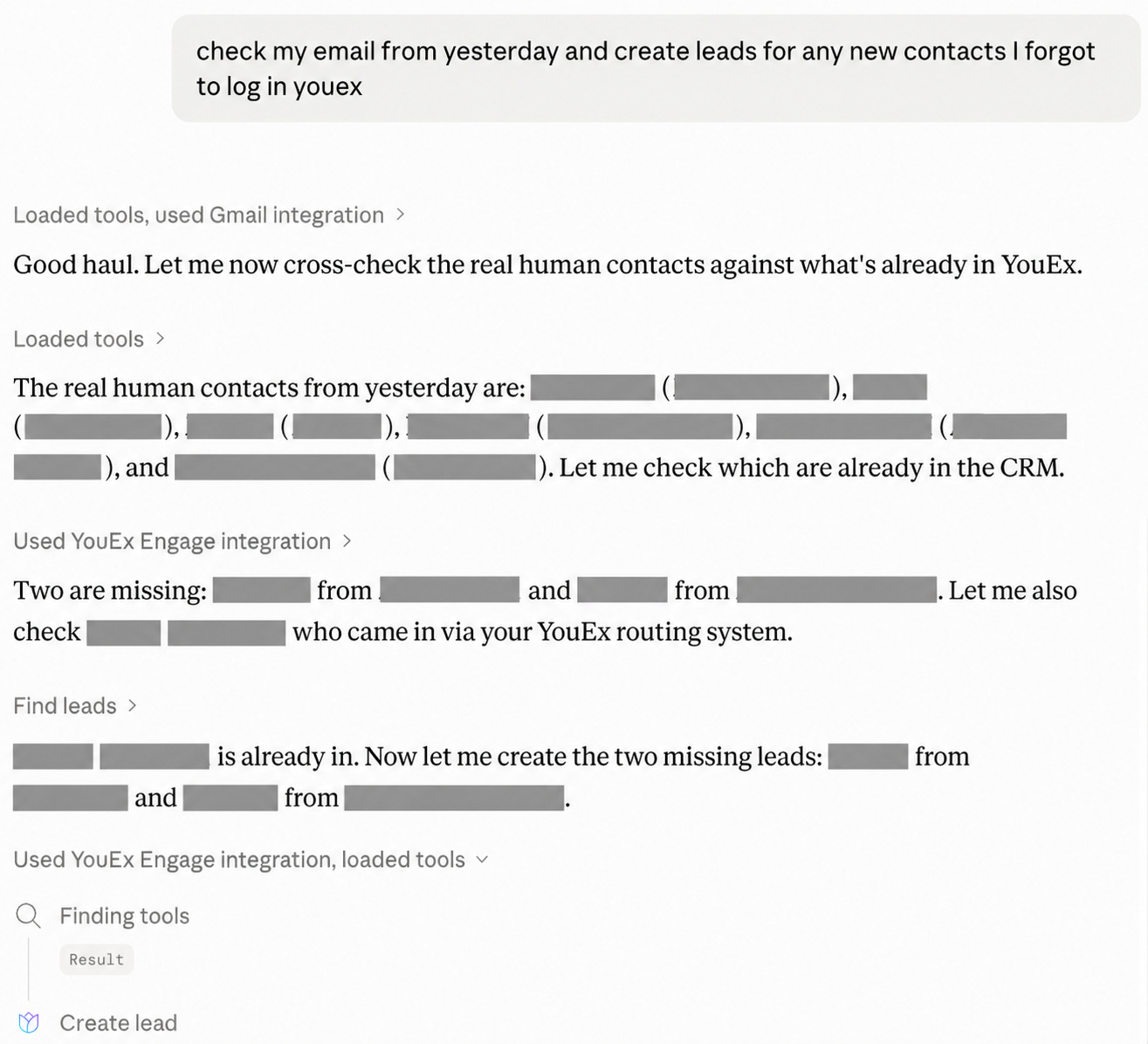
We meet the rep where the work actually happens. Most reps don’t live in a CRM tab. They live in their inbox, their phone, a chat window, the tools they already have open. So YouEx.ai Engage goes there. Web, GMail, Google Calendar, Outlook, Mobile, MCP, our ChatGPT app, Zapier, and a web agent all write into the same system. Getting information in is blazing fast. You capture a lead from wherever you are, in the flow you’re already in.
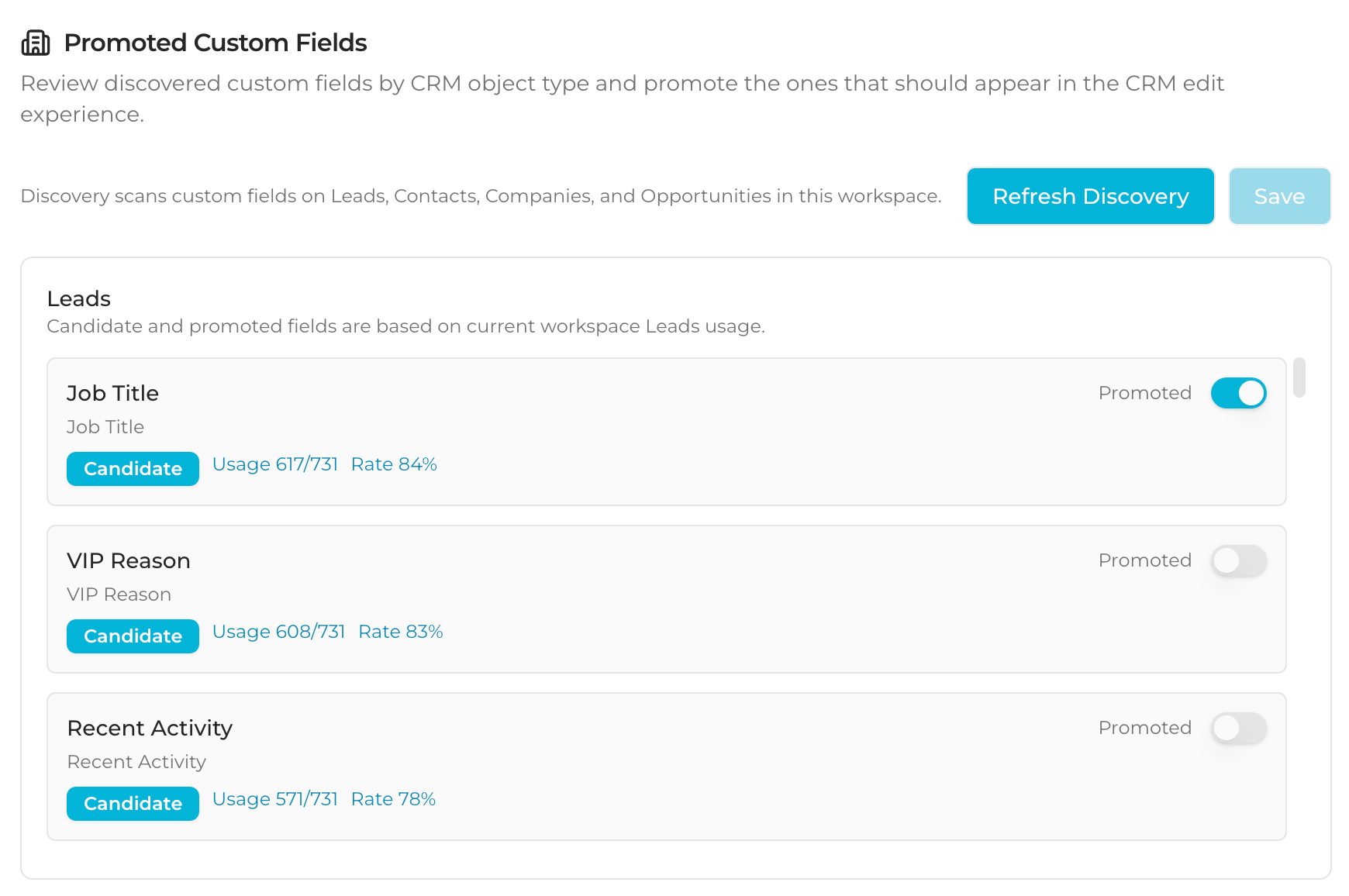
We keep administrative overhead close to zero. In most CRMs, adding a custom field is an IT ticket and a two-week wait. And then page layouts are littered with fields that someone requested but nobody uses.
In YouEx.ai Engage, a rep can add their own field the moment they need it. If it turns out to be useful, the system discovers it, and an admin can promote it so the whole team gets it. The structure of your CRM grows out of how your team actually sells, instead of being frozen by whoever configured it on day one.
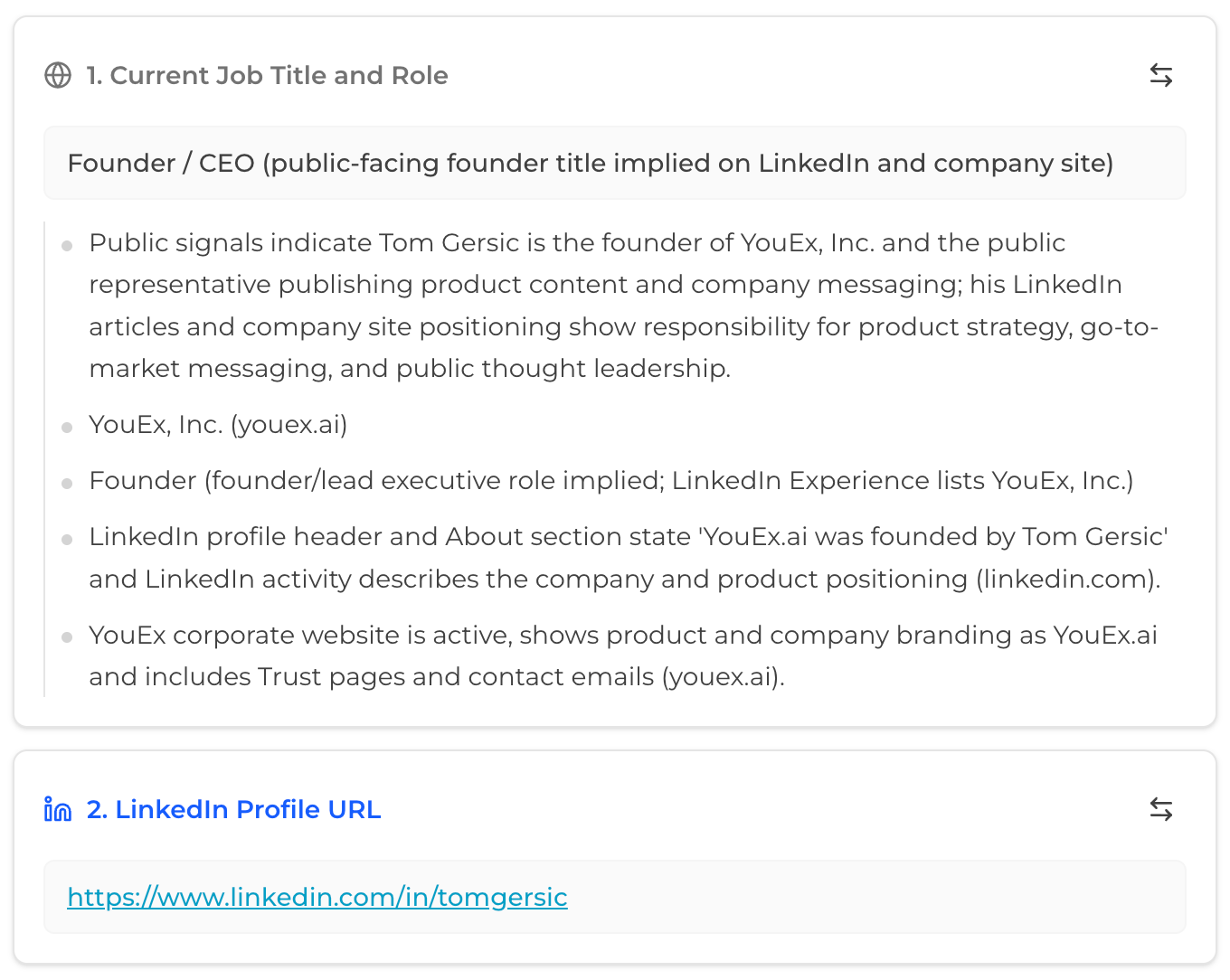
We research every single lead automatically. A blank record is a chore. A pre-researched record is a head start. Every lead that enters YouEx.ai Engage comes back enriched, so the data is authentically useful the moment it lands instead of being one more thing a human has to go fill in. The system earns its keep before the rep types a word.
We put contact data one click away. Email and phone numbers are right there, gathered on demand, without a second subscription to a separate data vendor bolted onto your stack. The thing reps usually pay extra to go find is built into the place they already work.
The actual fix
The standard playbook for low CRM adoption is more training and a threat about tying hygiene to commission checks. That has never worked, because it treats a design problem as a discipline problem.
Reps aren’t avoiding the CRM because they’re undisciplined. They’re avoiding it because the system asks them to do work that benefits everyone but them, and punishes them for going fast. Fix that, and you don’t have to beg anyone to use it. Build a system worth using, and the data shows up on its own. Then, and only then, do you actually get to see your pipeline.
That’s the whole idea behind YouEx.ai. Stop building tools that reps tolerate. Start building ones they reach for.