May 28, 2026
Your Web Form Is Costing You Half Your Pipeline.
The static contact form is the most expensive thing on your website. Not because it costs anything to run. Because of everything it lets walk away.
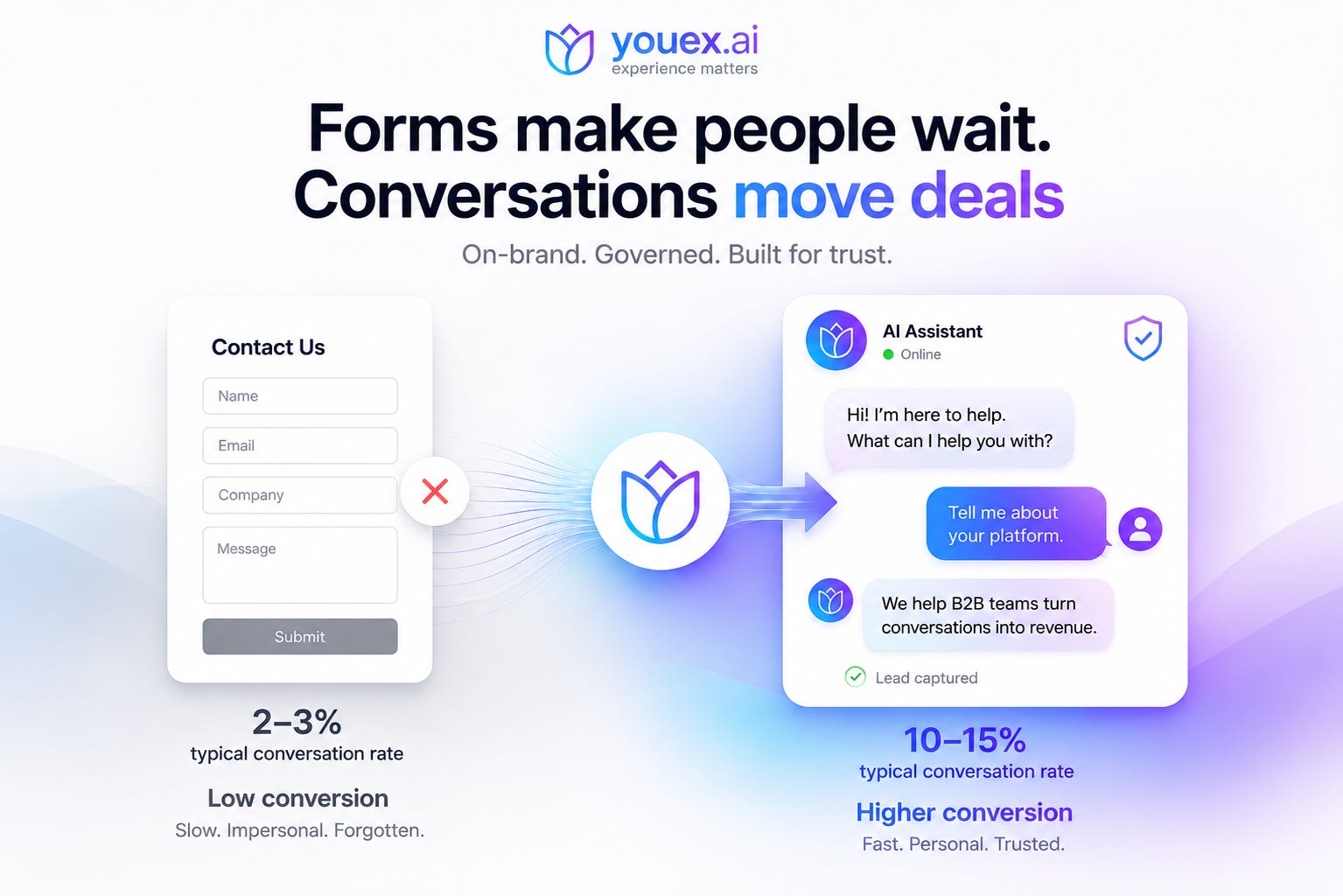
Yes, Drift named this problem “Kill the Form” nearly a decade ago. Forms make customers wait. And yet, web forms persisted because conversational AI wasn’t ready yet. Clunky chat agents are worse than a form. Even worse is waiting for a real person on the other side of the chat who can’t help anyway. But AI has caught up. Benchmark data from Leadoo, drawn from more than 400 companies across 25 industries, puts static contact form conversion at 2-3%. AI chatbots on the same kind of pages run 10-15%.
Static contact form conversion: 2-3%
AI chatbots: 10-15%
A 2025 field study in the Journal of Business Research, run across two experiments with more than 16,000 B2B participants, found the same gap in a peer-reviewed setting: conversational chatbots generated significantly more leads of higher quality than traditional landing pages and forms. The researchers traced the gap to three drivers: responsiveness, perceived security, and personalized experiences.
The thing that made chatbots win isn’t speed alone. It is whether buyers trusted what they were interacting with. Security and personalization are not features of the chat itself. They are features of the governance, content, and design behind the experience.
So the question isn’t “do conversational agents convert better?” That’s answered (yes. they do). The hesitation that’s left is more interesting, and most vendors talk around it because the honest version is harder to sell against.
The real worry isn’t that it lies. It’s that it’s not you.
Put an agent on your homepage and it stops being software. It becomes your brand, talking to a prospect, unsupervised, in the highest-stakes moment you have.
That’s the thing that should give you pause. Not some lurid fear that it’ll invent a fake refund policy. That is mostly last year’s problem, already solved. The worry now is subtler and it shows up in three ways:
It doesn’t sound like you. It’s accurate, it’s helpful, and it’s completely generic. The same beige “How can I assist you today?” voice as every other bot on every other site. You spent years building a tone. The agent throws it out on the first message.
It wanders off-message. Someone asks a sharp question and the agent freelances. It volunteers a comparison you’d never make, hedges on a point you’re firm about, or strays into positioning you abandoned two quarters ago. It’s not wrong, exactly. It’s just not what you would have said. And now a prospect thinks it is.
It buries the answer you’d lead with. A buyer asks about pricing and the agent gives a technically complete reply that misses the one framing you’d put first. The lead you’d open with ends up in paragraph three, if it shows up at all.
None of these trip an alarm. No customer files a complaint that your bot was a little off-brand. They just quietly decide you’re like everyone else, and they leave. That’s the failure that costs you, and it’s invisible until you go read the transcripts.
This is the whole thesis:
Intelligence isn’t enough. Your experience drives outcomes.
A smart model that represents you badly is worse than no agent at all, because it does it at scale, in your name, while you’re asleep.
Controlling that is just good UX
Keeping an agent on-brand isn’t a compliance chore or a safety feature. It’s the same discipline as good experience design: say the right thing, in your voice, with the right priorities, every time. When you build for that, three things have to be true, and they map directly onto how the YouEx.ai web agent works.
Your highest-stakes answers come out exactly as you’d say them. For the questions you cannot afford to get loose, pricing, positioning, how to reach a human, you set deterministic Q&A pairs that override the model entirely. The agent does not improvise on the answers that define you. It says the thing you approved, word for word, every time.
It speaks from your material, in your framing. Everything else is grounded in knowledge you curate: your files, your approved pages. Not the open internet. Not the model’s best guess at what a company like yours probably believes. Your content, which means your positioning, not a generic average of your category.
It sounds like you. Identity and tone are configured by the person who owns the message, not bolted on by a developer. The agent inherits your voice instead of defaulting to beige.
This isn’t guardrails in the defensive sense. It’s brand fidelity. The deterministic layer is you deciding, in advance, what the most important answers are and exactly how they should sound. That’s not a limitation on the agent. That’s the product.
Governance is good UX too, and the law is catching up to that
Starting August 2, 2026, the EU AI Act’s transparency obligations apply to any conversational AI that interacts with people. The obligation falls on the business running the agent, not just the vendor who built it. If you have EU visitors, you’re in scope. US regulators are moving the same direction, with state-level bot-disclosure rules already on the books.
Here’s the part most vendors get wrong when they talk about this. Compliance is not a switch you flip. The law treats governance as an operational discipline, not a feature. So the right thing to ask of an AI vendor is not “are you compliant for me,” because they can’t be. The right thing to ask is whether the product gives you the tools to govern the agent yourself, every day, on the record.
Six things matter in practice for a customer-facing agent, and the YouEx.ai web agent is built to support all of them.
Disclosure that the user is talking to an AI. Article 50 requires clear, timely notice. The agent’s identity and interaction surface are admin-configured, so disclosure is built in.
Traceability and auditability. Every conversation is logged and reviewable, with the configuration state that produced it. If you ever need to answer “what did the agent say, with what model, and why,” you can.
Human oversight. Allowed domains, an activation toggle, deterministic Q&A overrides, and the conversation review loop give you real intervention controls. You can constrain, modify, or shut down agent behavior at any time. That’s the meaningful-human-control test the regulation cares about.
Knowledge provenance and controlled grounding. The agent answers from material you approved. Not the open internet, not the model’s best guess. You govern what the agent is allowed to represent as truth, and you can see which sources were referenced in the conversation.
Output transparency. Users know they’re interacting with an AI, and the conversation record is preserved as machine-generated. Technical watermarking standards for AI output are still being finalized, but the operational transparency requirement is supported today.
Deployer accountability with vendor support. The law splits responsibility between the vendor who builds the system and the business that deploys it. You can’t outsource accountability, and we don’t pretend you can. What the platform does is reduce the operational burden of meeting it.
Strip away the legal language and look at what those six things actually are: be honest that it’s an agent, keep a record of what it said, control what it can say, ground it in approved material, and own your part of the accountability. That’s how you’d want to run a customer-facing agent even if no law existed, because it’s the only way you can answer the question that matters: is this thing representing me well?
You can’t tune what you can’t see. The law is just catching up to what good experience design already demanded. The YouEx.ai web agent was built for it from the first message.
Five minutes to launch. Governance is continuous from day one.
You can launch quickly because the governance architecture is already built into the product. The setup sequence is deliberately short:
Create one agent. Give it a name, a description, and the voice you want it to use.
Point it at one focused knowledge base. A few trusted files or pages is enough to start.
Add three to five Q&A pairs for your critical intents. Pricing, positioning, how to reach a human.
Add two or three lead fields, name, email, company, and turn on lead creation.
Set your allowed domains, activate, and paste the embed code on your site.
That’s it. You now have an agent that captures leads in conversation, answers from material you approved, in a voice you set, refuses to freelance on the answers that define you, and writes every exchange to a record you can read.
Then the real work starts, and it’s the good kind. You read actual conversations. You find the one where the agent’s tone drifted, or it answered a positioning question in a way you wouldn’t. You add a Q&A pair. You tighten the knowledge. The agent sounds more like you tomorrow than it did today. Speed to launch was never the achievement. The achievement is that you launched something on-brand on day one and made it sharper every day after.
What to actually measure
If you stand one up, watch these:
Speed to launch. Hours from “let’s try this” to live on the site.
On-brand rate. Read the transcripts. How often does the agent sound like you and lead with what you’d lead with, without a human stepping in?
Lead capture completion. Of the people who engage, how many leave you a usable contact?
Booked meetings. The only number your pipeline actually feels.
The form had one job and it does it badly: it waits. A governed conversational agent does the opposite. It answers in the moment, in your voice, on the record, and hands you a qualified lead while the buyer’s intent is still hot.
The conversion math was never the hard part. Trusting that the thing on your homepage actually sounds like you, that was the part worth getting right. And it no longer takes a quarter to do it.
Sources
Conversion benchmark data (static forms 2-3%, AI chatbots 10-15%): Leadoo benchmark of 400+ companies across 25 industries, summarized in Dashform, “AI Agents vs Forms for Lead Capture: 2026 Conversion Data”
B2B field experiment on chatbots vs. landing pages (16,000+ participants, peer-reviewed): Bressolles et al., “From static to conversational: The role of landing pages and chatbots in B2B lead generation,” Journal of Business Research, 2025
Drift “Kill the Form” campaign and conversational marketing category: Demanzo, “The Drift Playbook”
EU AI Act Article 50 transparency obligations (effective August 2, 2026): Official text of Regulation (EU) 2024/1689
YouEx.ai is the AI-native lead-to-revenue platform for B2B sales teams.