July 15, 2026
Your website is a brochure. Your visitors want a conversation.
I spent this week building AI chat engagement strategy playbooks for three very important customers: an employee engagement platform, a product engineering firm, and a information security company. Different industries, different buyers, different websites. The strategy that emerged was the same for all three, and it applies to almost any B2B site.
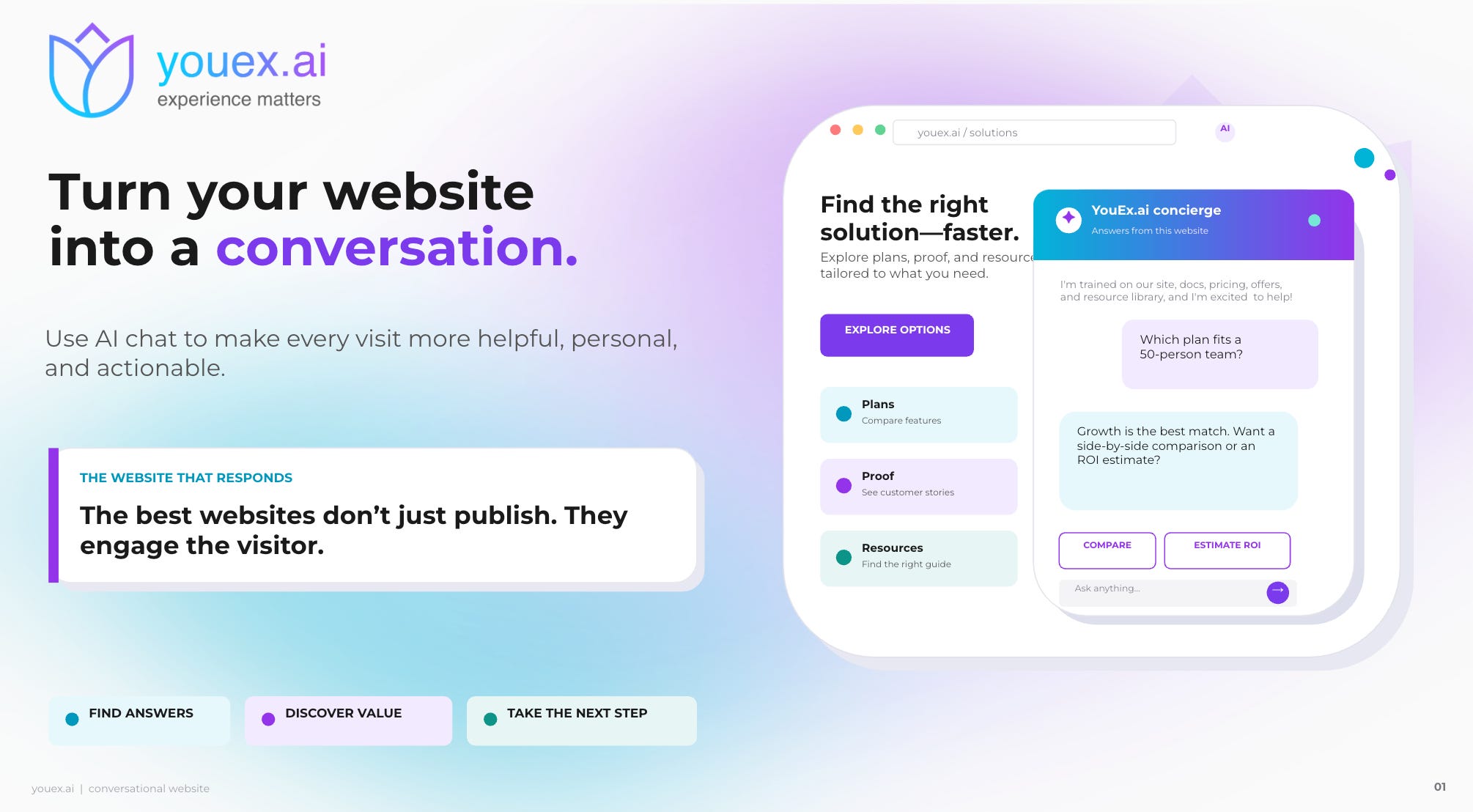
Here’s the short version: the chat is not a support widget. It’s a concierge layer across your entire conversion path. And many times companies that add AI chat to their site get almost nothing from it because they treat it like a support widget anyway.
The numbers say chat creates a more engaging and profitable web experience. So why doesn’t it?
The data on this is not subtle:
Intercom analyzed 20 million live chat messages and found visitors who chatted were 82% more likely to convert.
Meanwhile, Zuko’s benchmark data shows 55% of people who reach a form abandon it. Every form on your site is a tax on intent: before the visitor gets anything useful, you demand their information.
So if chat converts and forms leak, why do most chat deployments underperform?
Because your visitors have scar tissue. They remember keyword bots with rigid menus and dead ends. They remember “live chat” that was actually an outsourced agent reading a playbook, slower and more annoying than just picking up the phone. When they see a chat bubble in the corner of your site, they don’t think “instant answers.” They think “here we go again.”
A great LLM-based chat experience is nothing like that. But your visitors don’t know yours is different until you prove it. That’s the actual job.
The playbook in four parts
Every engagement I built this week runs on the same four pillars.
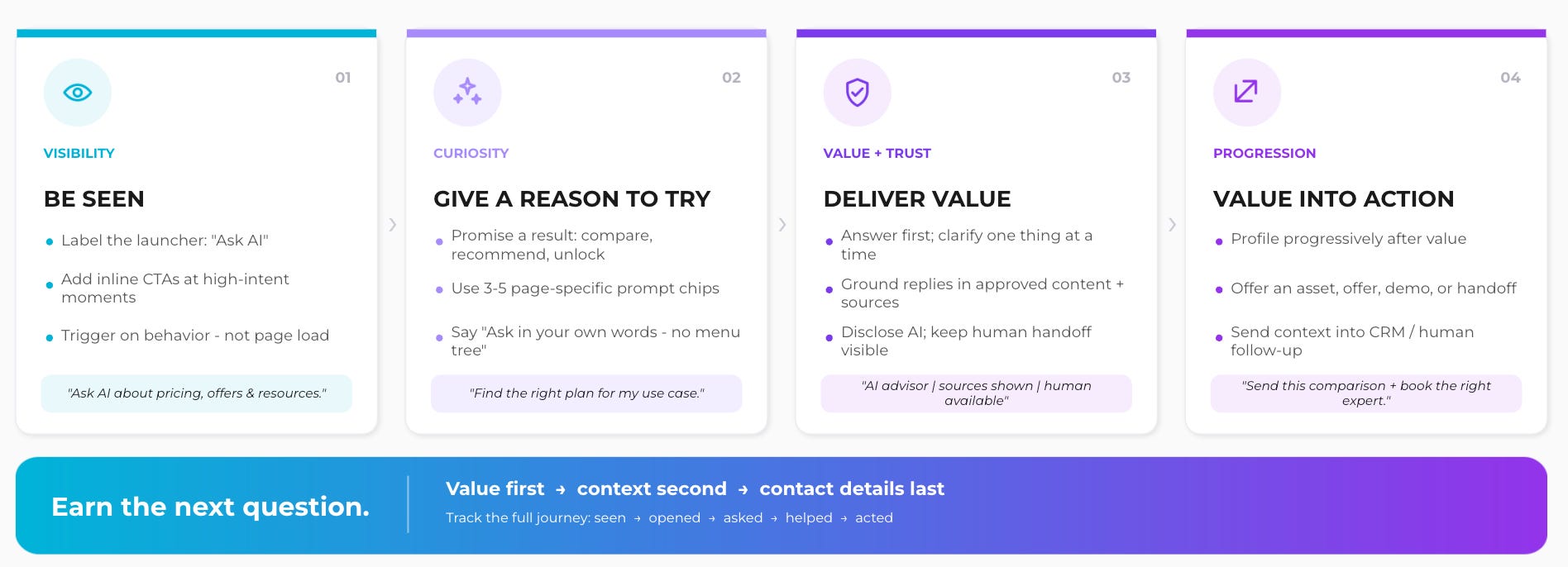
1. Be seen.
A small, unlabeled chat bubble in the corner is basically invisible. The most important thing you can do is make sure the visitor knows what value they can get from chat:
Make the launcher contextual to the page.
Add inline calls to action at high-intent moments: next to the pricing table, under the case studies, beside the quote request button.
And trigger proactively based on behavior, not page load.
A prompt that fires the instant someone lands is a popup. A prompt that arrives after someone has stared at your pricing page for 30 seconds is help.
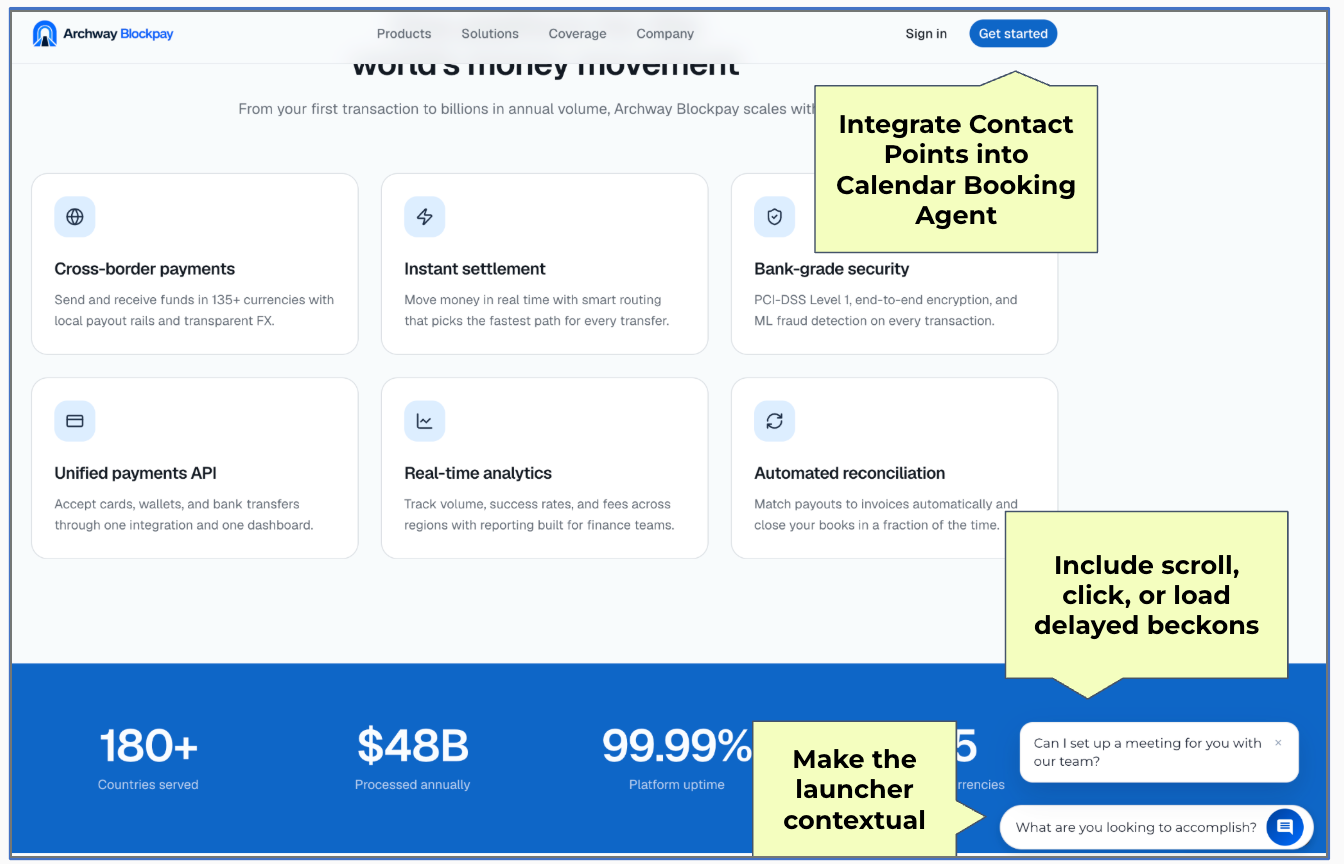
Youex.ai beckons are proactive messages that load after a period of time, after the user has scrolled to a point on the page, or after a click. These help draw visitor attention to things that chat can help with.
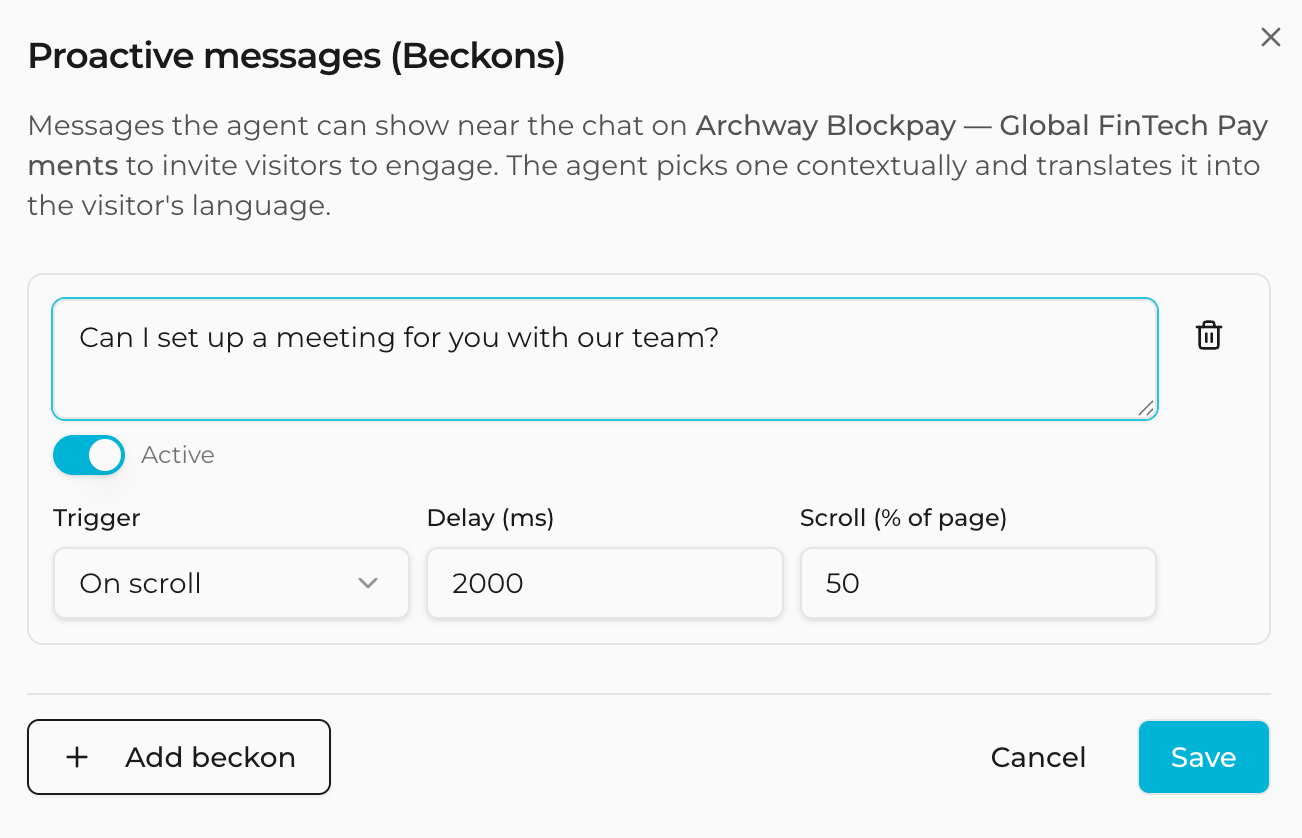
Want help setting up Beckons? It’s easy: under Knowledge Management, click the beckon icon on the page you want to add it to:

And then make sure you enable Beckons on the Agent, under Deploy:

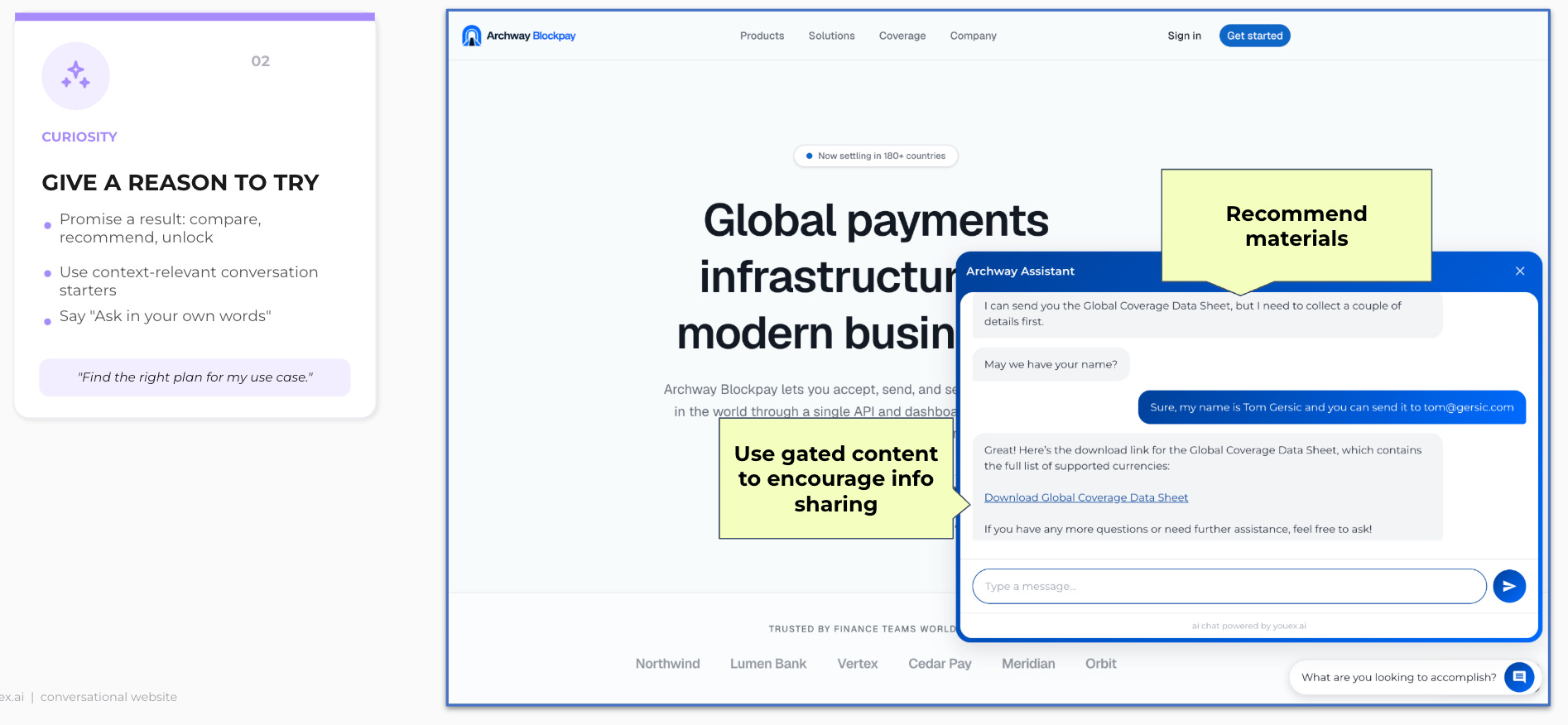
2. Give a reason to try.
“How can I help?” puts all the work on the visitor. Promise a result instead: compare plans, find the right guide, check eligibility, unlock a resource. Use conversation starters that match the page. Make it clear the user can ask anything in their own words. That one phrase directly disarms the old-bot expectation of menus and decision trees.
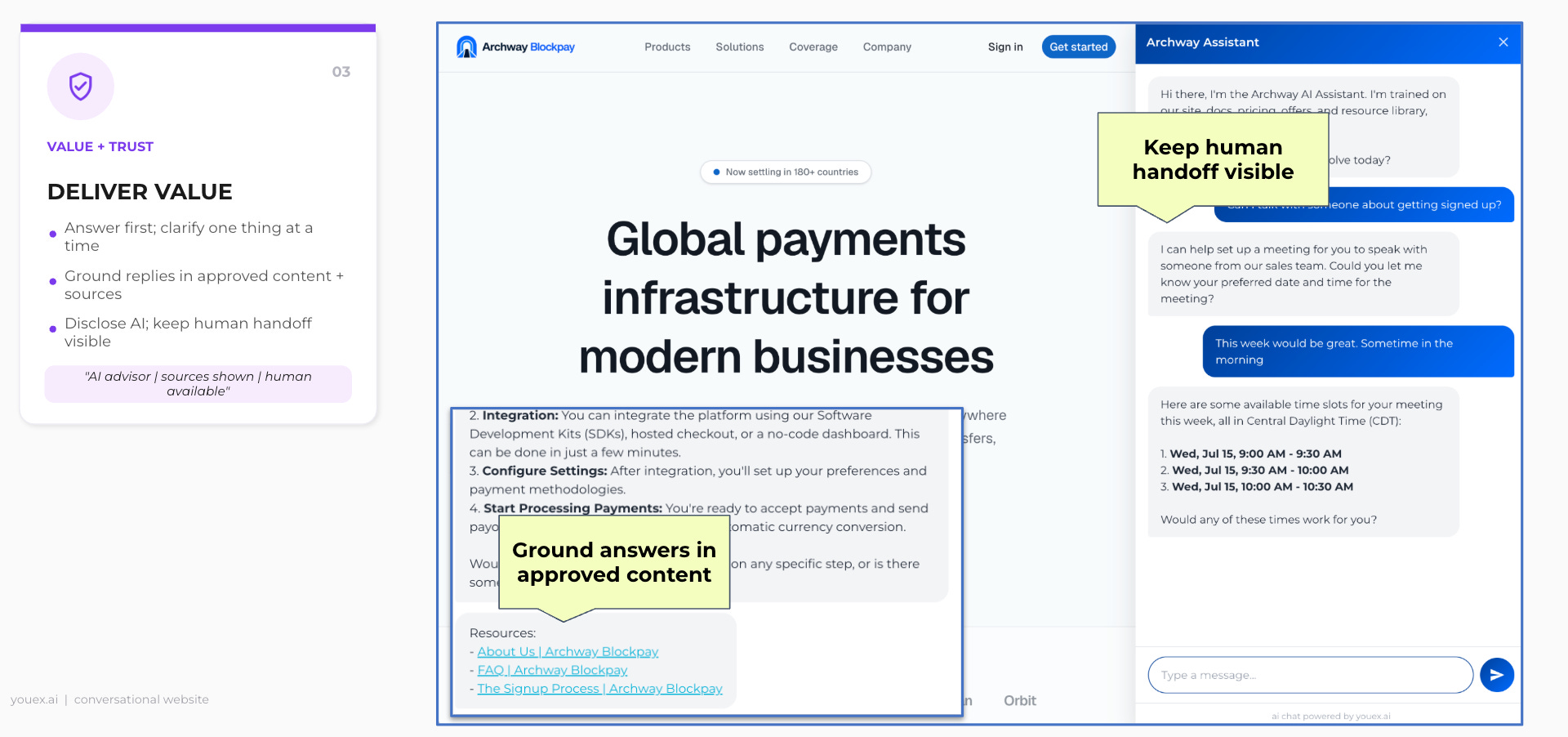
3. Deliver value, with trust built in.
Answer first. Clarify one thing at a time. Ground every reply in approved content and show the sources. Disclose that it’s AI, and keep a path to a human visible at all times. Salesforce’s research found 46% of customers are more likely to use an AI agent when there’s a clear path to a person. The escape hatch doesn’t undermine the AI. It’s what makes people willing to try it.
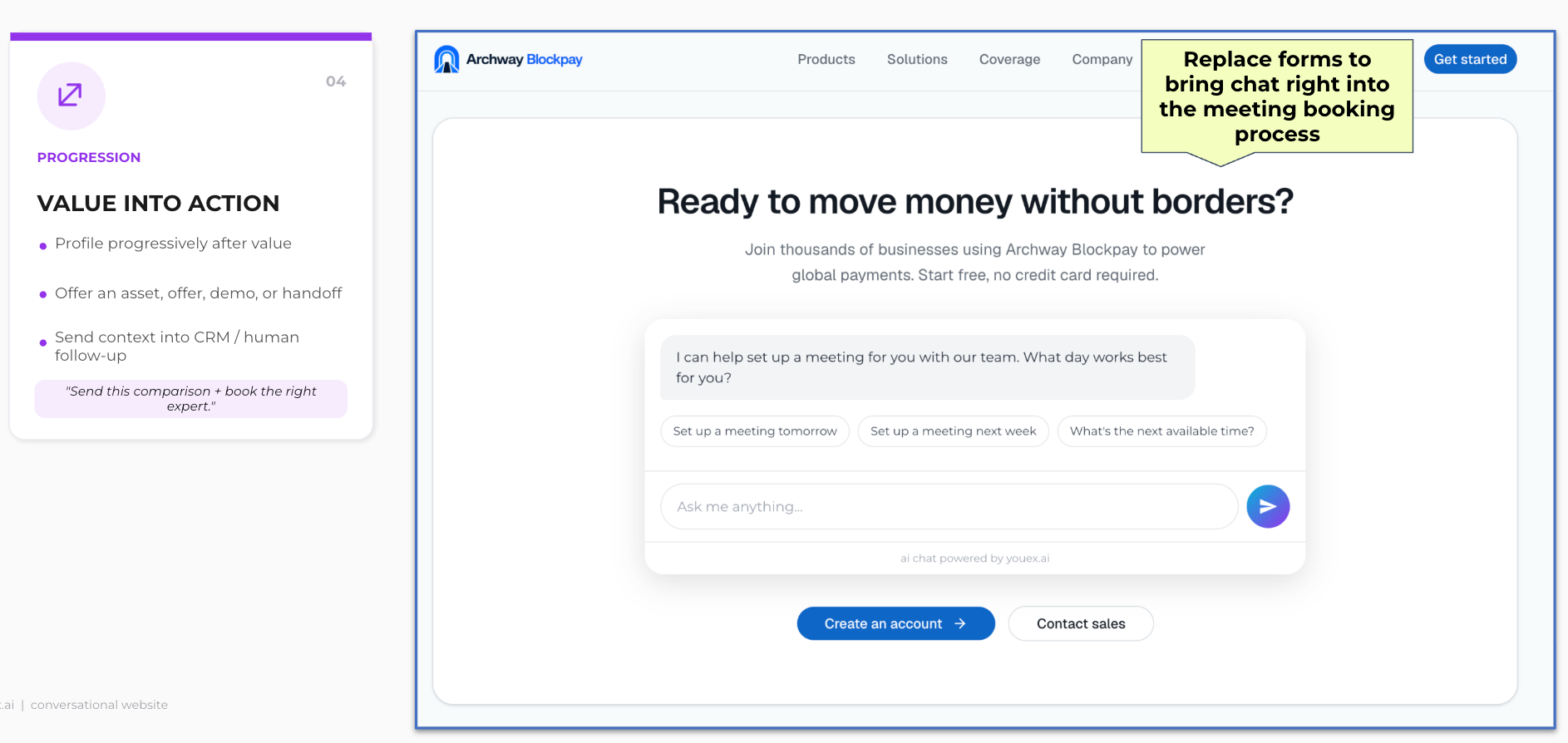
4. Turn value into action.
Once the conversation has been useful, move it somewhere: book a meeting, send a resource, apply an offer, start a trial, or hand off to a person with full context. Profile progressively along the way. Don’t ask for name, email, company, and budget upfront. That’s just a form wearing a chat costume.
The whole thing compresses into one principle: earn the next question. Value first, context second, contact details last.
Setup Help
Everything you’ve seen here is real YouEx.ai functionality. Want help getting it set up? Check out our config documentation here.
Or set up some time to chat with me here.
But what happens after the chat?
Here’s where this goes from a UX improvement to a revenue system.
Every conversation on your site is a qualification event. The visitor tells you their role, their use case, what they’re evaluating, and what’s blocking them. They do it voluntarily, in their own words, because the exchange is useful to them. That’s zero-party data no form will ever capture.
In the playbooks I shipped this week, each conversation produces a scored lead with an AI-generated research report, the pages the visitor viewed, every click interaction, and the full conversation history, all tied together in the CRM. The system explains why the lead landed in its tier, with the specific signals that drove the score. Your team doesn’t get a name and an email. They get a briefing.
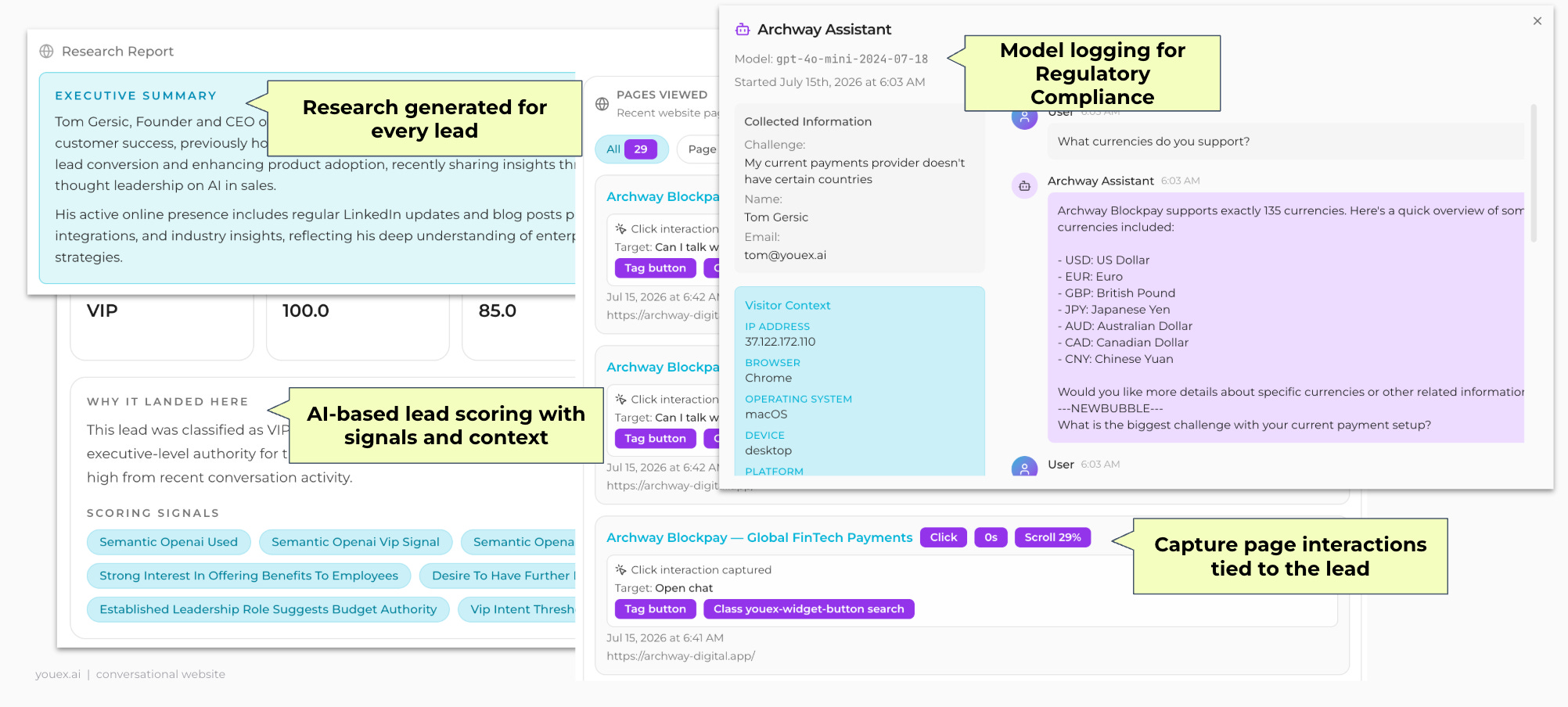
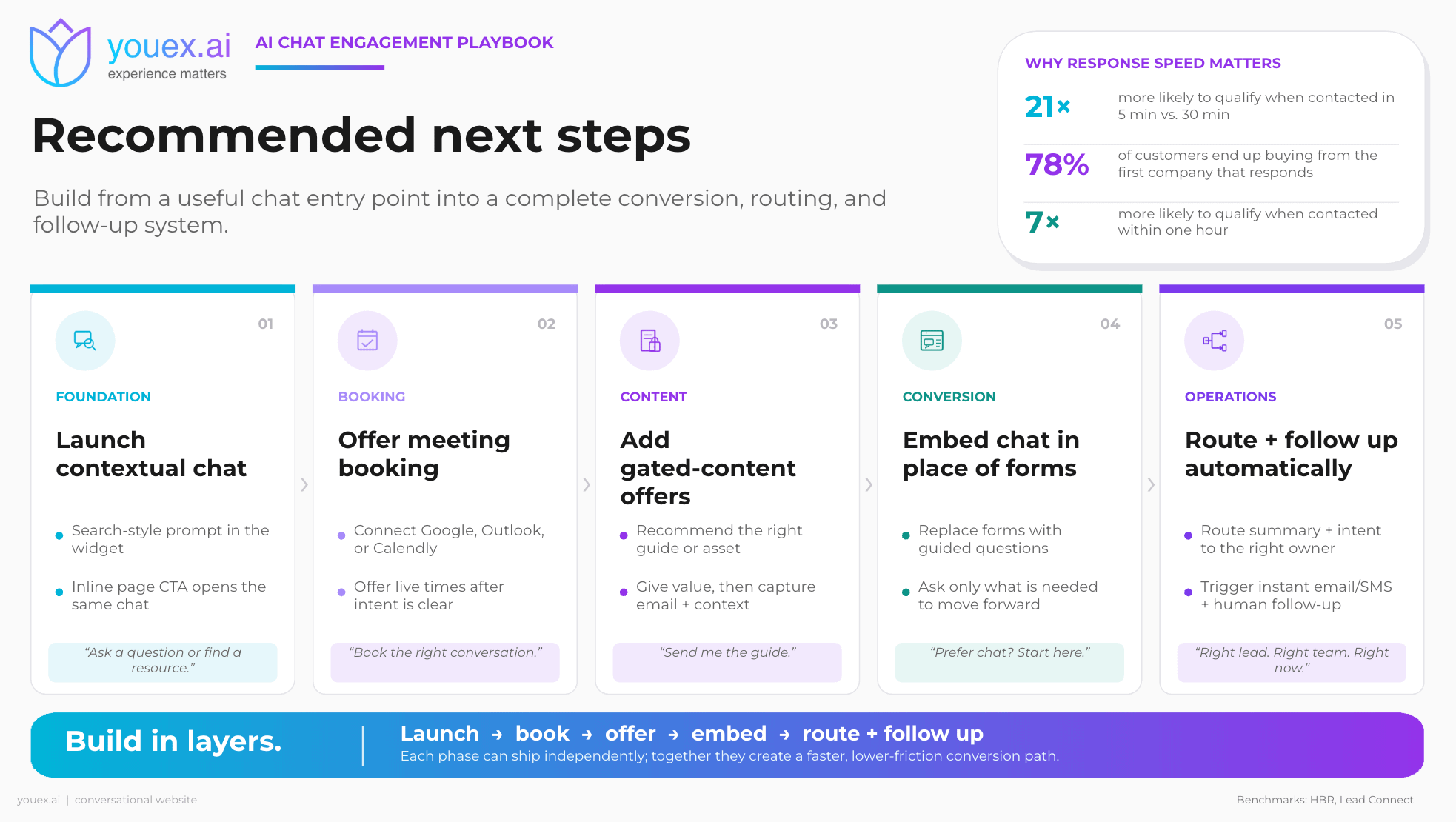
And speed matters more than most teams realize. Harvard Business Review’s classic lead response research found you’re 21 times more likely to qualify a lead when you contact them within 5 minutes versus 30. Most companies end up buying from the first vendor that responds. Chat plus automatic routing means the response starts while the visitor is still on your site.
Build it in layers
You don’t need to do all of this on day one. The rollout that works: launch contextual chat on your highest-intent pages, add meeting booking, add gated-content offers through the chat, replace your forms with guided conversation, then wire up routing and follow-up. Each layer ships independently. Together they turn a static website into your most productive rep, working every visit, at every hour.
The best websites don’t just publish. They engage the visitor. If your site can’t answer a question, make a recommendation, or book a meeting on its own, you’re leaving your most valuable traffic to fend for itself.
That’s the thesis behind everything we’re building at YouEx.ai. If you want to see what your website looks like as a conversation, come find me. Or better yet, ask the chat on our site. It knows the playbook.