May 20, 2026
AI Outreach Tools Are Built Backwards
There’s a pattern I see almost every week: a business leader buys an AI outreach tool, runs a campaign, gets thin results, switches to a second tool, gets thin results again, and ends up doing most of the work manually. They conclude that AI outreach doesn’t work.
The tools are part of the problem. But the deeper issue is that almost every AI outreach product on the market is built backwards.
The backwards model
The dominant architecture in this category goes: give us a buyer persona, we’ll generate the list, we’ll write the emails, we’ll send them, you’ll get meetings.
Every step of that workflow optimizes for volume. The list is as big as possible. The emails are as automated as possible. The send cadence is as aggressive as deliverability will tolerate. The pitch is “scale.”
In 2024 this still kind of worked, because inboxes weren’t yet saturated with AI-written cold email and the spam filters hadn’t fully adapted. In 2026, it doesn’t. Reply rates on volume-first outbound have collapsed. The tools haven’t changed; the world has.
The right architecture in 2026 is inverted: give us a hypothesis about who you should be talking to, we’ll help you find the 100 best-fit prospects, we’ll surface the context that makes each one worth a real email, you’ll send something a human wants to reply to.
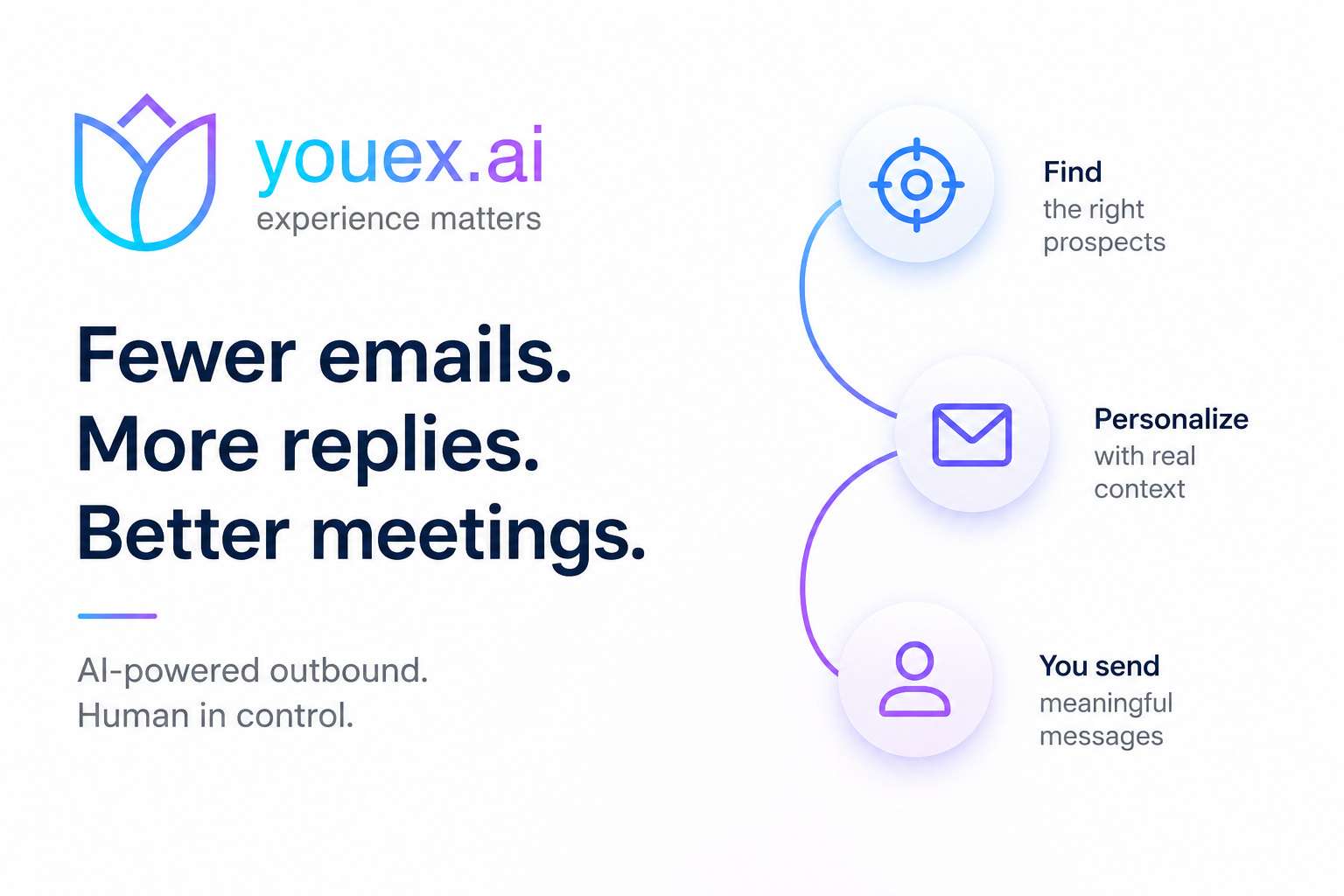
That’s a smaller market for vendors. It’s also the model that actually produces meetings now.
The three places AI actually helps
Outbound is three problems: lead data, personalization, and deliverability. AI moves the needle on each, but not in the way the category has been selling.
Lead Data: Apollo and ZoomInfo will return thousands of contacts for any reasonable ICP. The catch: 60–70% of records are wrong, stale, or pointing at people who left eighteen months ago. AI’s real job here isn’t finding leads, it’s scoring them, deduplicating them, and killing the bad ones before they cost you a domain reputation point. Layered research does more for your reply rate than any subject-line generator ever will.
Personalization: The word has been so thoroughly abused it’s almost meaningless. “Hi {{firstName}}, I saw {{company}} is in the {{industry}} space” isn’t personalization, it’s mail merge in a costume. What works in 2026 is earned context (something you’d only know after ten minutes of research) and relevance (a specific reason this email is landing in their inbox *this week*). Our internal analysis: emails referencing a defensible, specific signal outperform generic personalization by roughly 3–4x on reply rate. AI can absolutely write these emails if it’s been given the right research context and the right voice. The mistake isn’t using AI to draft. The mistake is letting AI also decide what to send and when.
Deliverability: Most founders learn this one by burning their primary domain. The basics are non-negotiable: SPF, DKIM, DMARC, a secondary sending domain, warmed inboxes, volume caps that respect what Google and Microsoft will tolerate from a new sender. The practical rule: more than 30–40 cold emails per inbox per day without an unsubscribe link and you’re in dangerous territory. Most tools let you violate these rules. Few warn you before you do.
What this means in practice
Stop looking for a tool that runs outreach without you. No such tool produces good results in 2026. The ones that promise it are selling you the right to burn your domain.
Look instead for tooling that does the heavy lifting: sourcing, enrichment, deduplication, scoring, drafting, and follow-up sequencing, while still putting you in the loop at the point of send. That’s the architecture that actually works.
Be ruthless about list quality. A list of 100 great-fit prospects will outperform a list of 2,000 “matched” contacts every time. The bottleneck is not your ability to send; it’s your ability to identify who’s worth sending to.
Read the draft before it goes out, at least at the start. You’ll learn more from reading what the AI proposes (and what you change) than from any analytics dashboard. Once you trust the voice and the targeting, you can scale the volume. Not before.
What we’re building, and why
We built YouEx.ai for the human-in-the-loop model. A B2B sales platform focused on lead capture, enrichment, scoring, drafting, and workflow automation for SMB sales teams. Our app will draft your messages, surface the context that makes them worth sending, and queue them up. What it won’t do is hit send for you. That call stays with the human, because that’s the call that matters.
The teams we work best with have a specific buyer profile, a real product, and the discipline to send fewer, better messages. If that’s you, I’d love to talk.
---
Tom is the founder and CEO of YouEx.ai, an AI-native B2B sales platform for SMB sales teams.