March 17, 2026
Intelligence Isn't Enough
AI helps your best people be exceptional
The companies that win with AI over the next decade won’t be the ones that figured out how to do the same work with fewer people. They’ll be the ones that figured out how to make their best people dramatically more powerful.
That’s not a feel-good statement. It’s what the data actually shows. And it has significant implications for how you should be thinking about AI in your business right now.
Here’s a number that should make every business leader uncomfortable: only 5% of companies are getting substantial value from AI at scale. These are companies that have invested heavily, deployed broadly, and are still waiting for the return.
That’s from BCG’s global study of 1,250 firms. 60% of companies are seeing no material value at all.
This is not an adoption problem. 88% of organizations are using AI in at least one business function. The tools are everywhere. The investment is real. And the business results are, for most companies, close to nothing.
The problem isn’t the AI. It’s how AI has been deployed.
The industry has been solving the wrong problem
The enterprise AI conversation has been almost entirely about capability: Which model is smarter. Which platform has better reasoning. Which vendor has the best benchmark scores.
That was always the wrong frame.
McKinsey surveyed nearly 2,000 leaders and asked what separates the small number of companies getting meaningful results. The answer wasn’t model quality or budget size. It was workflow redesign. The companies winning with AI have fundamentally changed how work gets done. The companies losing have handed people new tools and left the work itself unchanged.
BCG puts it even more directly: 70% of AI transformation effort should go to people and processes. Only 10% to the algorithms. Deloitte found the same thing from a different angle. 84% of companies have not redesigned jobs or the nature of work itself around AI capabilities. They’ve trained people on tools. They haven’t changed the work.
There’s a word for deploying powerful technology without changing the system it runs in. It’s called a pilot. And most companies are living in permanent pilot mode.
Sequoia Capital put a specific number on the opportunity this creates. For every dollar spent on software, six dollars are spent on services - outsourcing, agencies, contractors doing intelligence-heavy work that AI can now assist with. The companies that redesign workflows around AI don’t just capture the software budget. They start capturing the services budget too. That’s where the real commercial opportunity is.
The companies that figure this out aren’t asking “which tasks can we automate?” They’re asking “which workflows can we redesign so our best people are focused entirely on the work that requires human judgment?”
The gap to think about
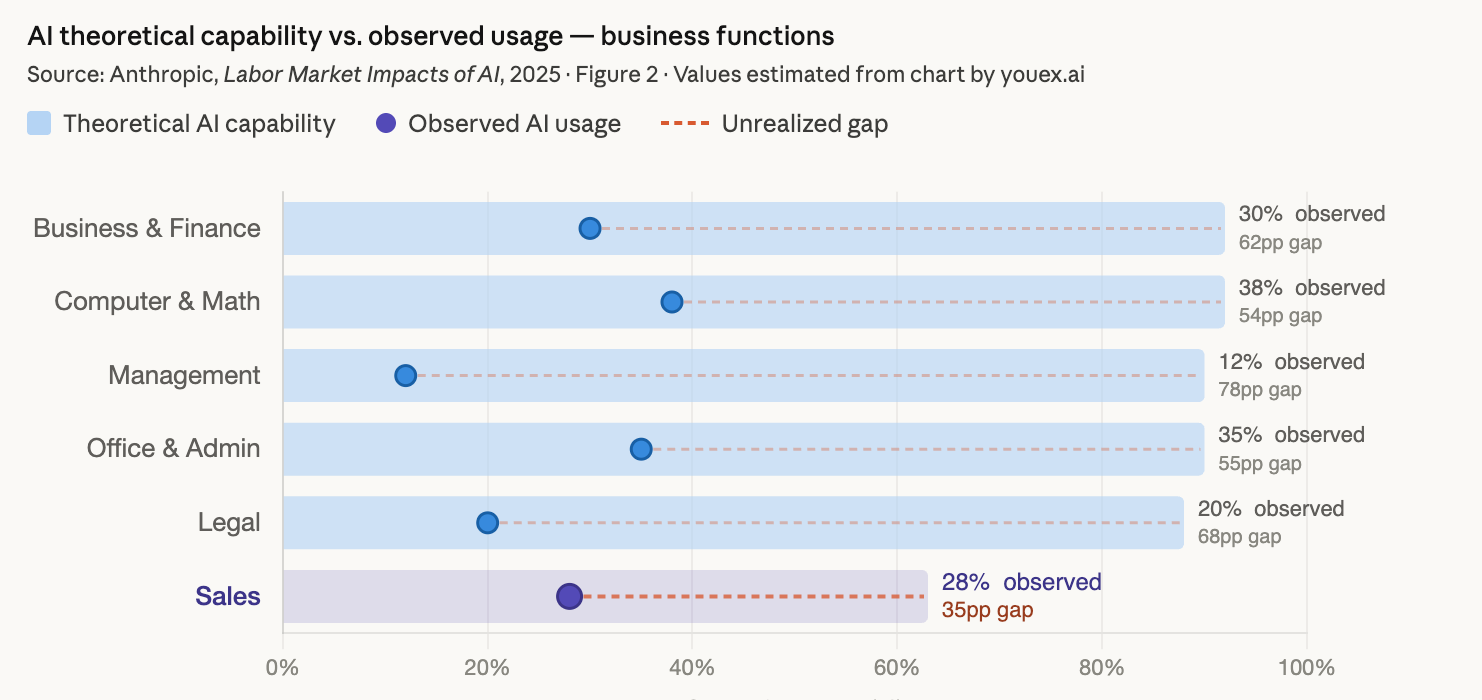
Anthropic published labor market research mapping AI’s theoretical capability against actual observed usage across every major occupational category. The results are striking across the board - there’s a gap between what AI could do and what it’s actually doing in almost every field.
Sales stands out — here’s why:
According to Anthropic, Sales has a theoretical AI capability ceiling of around 63% of tasks. These are roles that benefit more from augmentation than automation. AI doesn’t replace sellers, it frees up sellers to focus on selling. Observed actual usage is around 28%. That’s a 35 percentage point gap - more than a third of the potential sitting on the table, uncaptured.
Here’s the thing that makes that number interesting rather than simply disappointing: sales workers are already reaching for AI more than most other groups outside of computer programming. The observed usage is growing. The hunger is there. The problem isn’t reluctance. It’s that nobody has built the right experience for how sales people actually work.
A second Anthropic study published in February 2026 shows exactly where agents are being deployed today. Analyzing nearly one million real-world agent tool calls, the data is unambiguous: software engineering accounts for nearly 50% of all agentic activity. Sales and CRM? 4.3%.
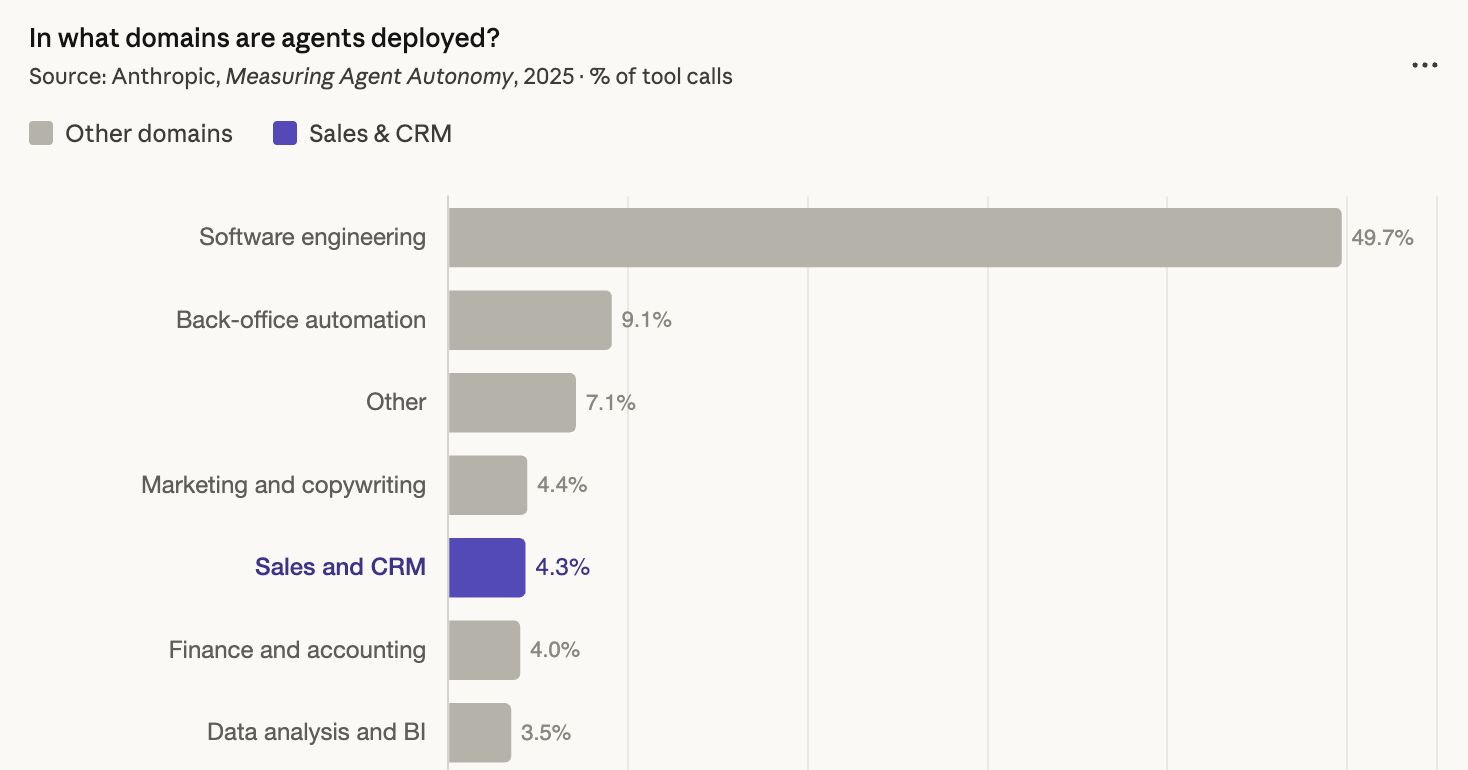
This isn’t a surprise - it mirrors the same pattern we saw with AI tools more broadly. Software engineers got purpose-built experiences first. Other professions are still waiting. Anthropic’s own conclusion from this data: as agents expand into sales, customer service, and finance - the frontier will expand rapidly. The capability is there. The deployment hasn’t happened yet.
McKinsey’s data confirms where the value is. Revenue gains from AI are most consistently reported in marketing and sales - year after year. The ROI exists. It’s just not being unlocked at scale.
“We thought we were going to automate jobs. The truth is, you’re not. You’re going to give existing workers force multipliers where they can be more effective.”
- Deloitte State of AI in the Enterprise 2026
This is where the frame shifts. The question was never how to replace sales reps with AI. It was always how to make them dramatically more effective. The companies doing this well aren’t focusing in reducing headcount - they’re just winning more deals with the same team.
Why experience is the real bottleneck
Claude Code works. OpenAI Codex and Github Copilot work. In fact, they work really well. That’s because they were designed for exactly how developers work - embedded directly in the IDE, zero context-switching, no new workflow to learn. The AI fits the work.
That hasn’t happened yet for sales. The AI tools available to a sales rep today mostly mimic developer tools. They ask sellers to leave their workflow, open a new tool, describe their situation to a general-purpose model, and adapt the output back to their context. That’s not AI in the workflow. That’s AI as an additional job.
Do you want your sellers learning how to write developer-focused slash-commands and deploying locally hosted agents, or do you want them out talking to your customers and closing deals?
Deloitte’s experts put a specific number on it: most enterprise AI tools are running about a year to two years behind consumer tools in user experience. Workers don’t want to swivel-chair between tools. They want AI that fits how they already work.
This is the actual bottleneck. Not the model. Not the investment. The experience.
The companies in BCG’s top 5% - the ones achieving 1.7x revenue growth and 3.6x shareholder returns compared to laggards - didn’t get there by buying better AI. They got there by redesigning the experience of the work so that AI was embedded into it, not layered on top of it.
The gap between where enterprise AI is and where it should be isn’t a technology problem. Every major research firm studying this has reached the same conclusion: the bottleneck is people, process, and experience design.
In sales, that gap is enormous and largely unaddressed. The capability is there. The appetite is there. The workflows haven’t been redesigned, and the purpose-built experience layer doesn’t exist… yet.

Sources
BCG, The Widening AI Value Gap: Build for the Future 2025 - bcg.com/publications/2025/are-you-generating-value-from-ai-the-widening-gap
McKinsey, The State of AI in 2025: Agents, Innovation, and Transformation - mckinsey.com/capabilities/quantumblack/our-insights/the-state-of-ai
Deloitte, State of AI in the Enterprise: The Untapped Edge - deloitte.com/us/en/what-we-do/capabilities/applied-artificial-intelligence/content/state-of-ai-in-the-enterprise.html
Anthropic, Labor Market Impacts of AI - anthropic.com/research/labor-market-impacts
Anthropic, Normalized Automation by Category - huggingface.co/datasets/Anthropic/EconomicIndex/blob/main/release_2025_03_27/normalized_automation_by_category.png
Anthropic, Measuring AI Agent Autonomy in Practice - anthropic.com/research/measuring-agent-autonomy
Sequoia Capital, Services: The New Software - sequoiacap.com/article/services-the-new-software/