November 10, 2026
Anthropic's new frontier meets health care's trust test
Sanofi says AI tools now touch more than 90% of its small-molecule research portfolio. The company pairs that scale with its RAISE (Responsible AI at Sanofi for Everyone) governance framework and keeps scientific, ethical, and accountability decisions with people. The practical signal is not simply broad adoption. It is that portfolio-scale AI needs a portfolio-scale trust system around it.
Executive snapshot
Anthropic moved the frontier again: Claude Fable 5.2 is broadly available, while the less-restricted Mythos 5.2 remains limited to vetted cyber and life-sciences users.
OpenAI opened another enterprise buying path: ChatGPT Enterprise, plus eligible Healthcare and Financial Services editions, can now be purchased through AWS Marketplace.
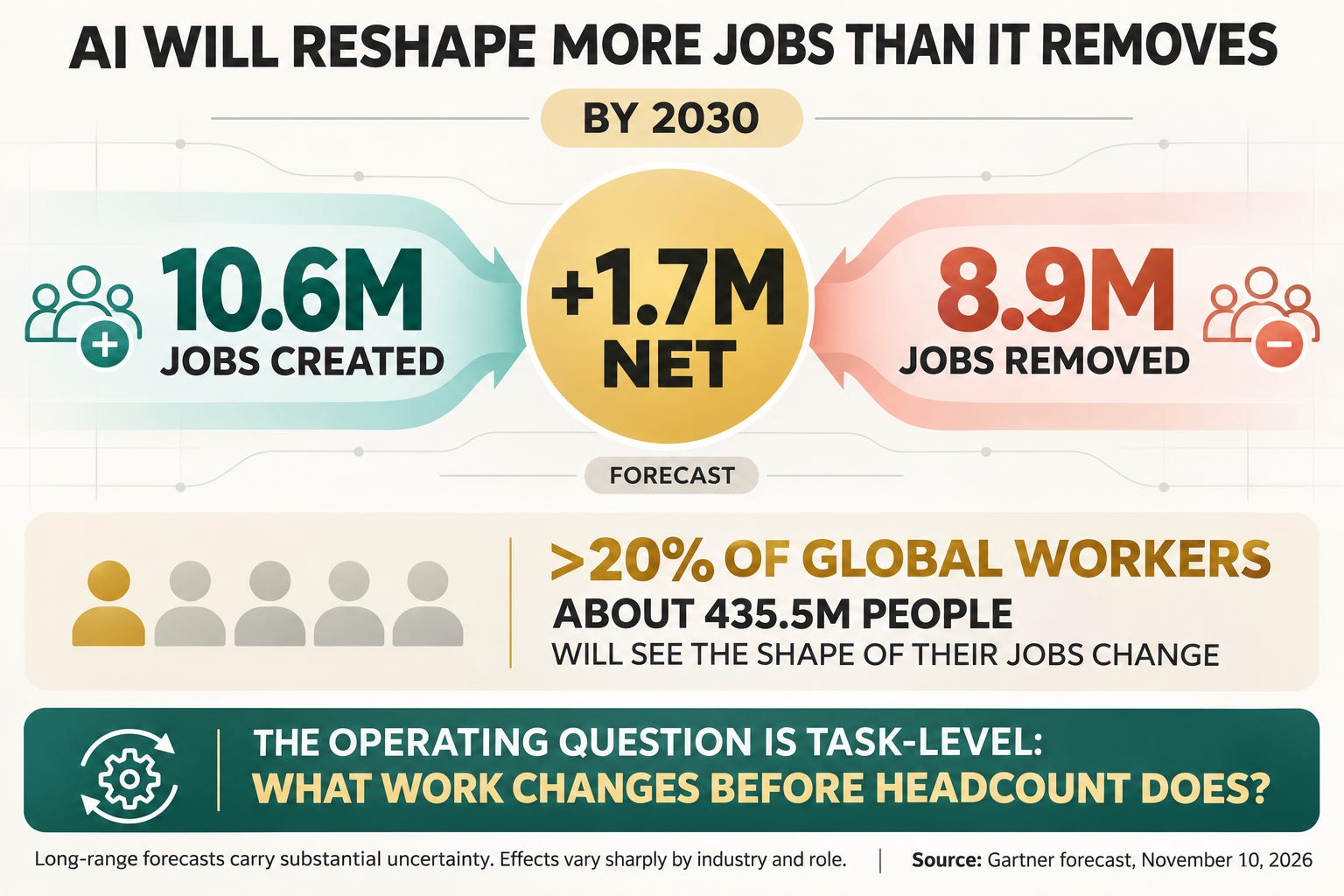
Analyst signal: Gartner forecasts 10.6 million jobs created and 8.9 million removed by AI through 2030, with more than 20% of workers seeing their jobs reshaped.
Field execution is becoming proactive: Motive launched agents that can monitor check-ins, dispatch, fuel, maintenance, and safety, but published no customer outcome evidence with the release.
Top developments
Anthropic’s new frontier comes with a usage map
Anthropic released Claude Fable 5.2 across its platform, AWS, Google Cloud, and Microsoft Azure. Anthropic reports 49.1% on FrontierCode 2.0 at its highest effort setting and 51.4% on AutomationBench, although Gemini 4 Carbon scored higher on the latter at 53.9%. Mythos 5.2, the less-restricted version for sensitive cyber and biology work, remains available through verification programs. These are vendor-run results, so the useful next step is a workload evaluation with the same tools, data, cost ceiling, and review process used in production. Anthropic announcement and evaluations
The cloud commitment is becoming a software buying channel
OpenAI made ChatGPT Enterprise available through AWS Marketplace, allowing eligible organizations to use existing AWS purchasing, billing, and committed spend. Eligible customers can also access ChatGPT for Healthcare and ChatGPT for Financial Services through the marketplace. This does not change the product’s underlying capability, but it can change procurement time, budget ownership, and vendor review. For enterprise sellers, commercial architecture now includes where the customer already has spend and approval paths. OpenAI announcement
OpenAI puts the stop control below the workload
OpenAI described Control Room, an internal system that authorizes every research inference request and can stop further model output within 35 seconds of a termination instruction. The control sits at the more centralized inference layer rather than inside fast-changing workload code, and the system fails closed if Control Room becomes unavailable. It is an internal research system, not a customer product, but the design principle travels well: consequential agent controls should live where individual applications cannot bypass them. OpenAI technical report
Gartner’s jobs forecast shifts attention to work redesign
Gartner forecasts that AI will create 10.6 million jobs and remove 8.9 million through 2030, a net increase of 1.7 million. It expects more than 20% of global workers, about 435.5 million people, to see the shape of their jobs change. Forecasts at this horizon carry substantial uncertainty, and Gartner cautions that effects vary sharply by industry and role. The operating implication is more immediate: leaders need task-level evidence before making headcount assumptions. Gartner forecast
AI for Sales and field execution
Field agents move from answering to watching
Motive launched AI agents for landscaping, pest control, plumbing, HVAC, and related field-service teams. The agents can monitor driver management, dispatch, fuel, maintenance, safety, check-ins, and driver tracking, then take routine actions. The release names workflows but provides no deployment metrics, so buyers should ask for false-alert rates, override behavior, escalation time, and downstream measures such as schedule adherence, avoided downtime, and repeat visits. Motive announcement
Twenty times more output required a different approval system
CodeRabbit says it has shipped roughly 20 times more software over the past six months with the same engineering team using Codex. The more useful detail is what came next: the company reworked testing and release processes, moved human approvals to higher-risk changes, and allowed some low-risk changes to ship automatically. The figures are company-reported and are not an independent productivity study. For revenue operations, the parallel is direct: higher agent throughput makes tiered review, evidence, and exception handling more important, not less. OpenAI customer story
Practical sales implication: a model upgrade creates value only when it improves a measurable step in the seller’s day. That can be a better account brief, a more accurate next action, a faster quote, or a cleaner CRM update. This is where YouEx.ai’s live CRM access through ChatGPT and Claude is useful: the assistant can work from current lead, relationship, and opportunity context instead of asking the seller to reconstruct it in a prompt.
Health Care, Pharma, MedTech, and Medical Devices
Sanofi’s scale test is now a trust test
Sanofi says AI is embedded across more than 90% of its small-molecule research portfolio. Its RAISE framework is intended to keep governance, ethics, and accountability aligned with that use. The disclosure establishes breadth, not clinical outcomes or cycle-time improvement. The next evidence to seek is where AI changes a research decision, how outputs are validated, and which measures reveal drift after deployment. Sanofi interview | Sanofi RAISE Guiding Principles
Clalit designs a digital front door around access barriers
Google.org and Clalit Health Services announced a two-year grant to develop a multilingual, voice-enabled assistant using Google Cloud and Gemini. The planned system would help patients complete intake, navigate preliminary assessments, schedule appointments, and manage follow-up, with attention to dialect, culture, and digital literacy. No grant amount, launch date, or outcome data was disclosed. The meaningful test will be whether the assistant reduces abandonment and improves completed care steps without widening access gaps. Announcement coverage
Ultrasound AI moves closer to the scan itself
ContextVision and BeamWorks signed a co-development and global marketing agreement for real-time, on-device ultrasound AI. Their first product is underway, combining ContextVision’s image enhancement with BeamWorks’ context-aware semantic enhancement, which is intended to sharpen tissue boundaries and lesion features during scanning. BeamWorks’ existing breast-ultrasound system has FDA 510(k) clearance and CE certification, but the new co-developed product has no announced clinical application, clearance, performance data, or launch date. Company release
Pharma AI infrastructure is trading convenience for control
TrueFoundry described one European pharma company isolating sensitive workloads even when that meant giving up caching, while another introduced controls over agent access to enterprise tools gradually. AstraZeneca’s global head of AI delivery separately cited progress establishing an AI gateway foundation across models, agents, MCP servers, and enterprise systems. These are vendor accounts without quantified outcomes, but they expose a real operating tradeoff: latency and convenience may need to yield to data boundaries, tool permissions, and regional governance. TrueFoundry account
What to watch
Independent, repeated-run evaluations of Fable 5.2 on enterprise workflows, especially where Anthropic’s own AutomationBench result trails Gemini 4 Carbon.
Whether AWS Marketplace availability materially shortens contracting for regulated ChatGPT editions, or merely changes the invoice path.
Clalit’s first deployment scope, launch timing, accessibility measures, handoff rules, and completed-care outcomes.
The clinical application, regulatory path, and prospective performance evidence for the first ContextVision and BeamWorks product.
Field-agent evidence that separates actions taken from problems prevented, customer time saved, and service revenue created.