July 30, 2026
Conversational Website Statistics: Speed, Trust, Forms & Lead Response
Do visitors to your website find it engaging? Do they find value in the experience? How often do they return? How long do they stay? Do you know?
Websites are still designed like brochures: they publish information and offer little direct value to the visitor. If a visitor has a question, they fill out a form and wait. Most won’t. Evidence points to a more useful model: answer the question quickly, make a clear next step easy, and ensure every signal reaches the right person. AI chat makes every visit more helpful, personal, and actionable.
A strong website does more than publish information. It helps a visitor get an answer, find the right next step, and connect with the right person while intent is still high. Here are the statistics behind that approach, with links to the best available sources.
Do visitors actually expect an immediate answer?
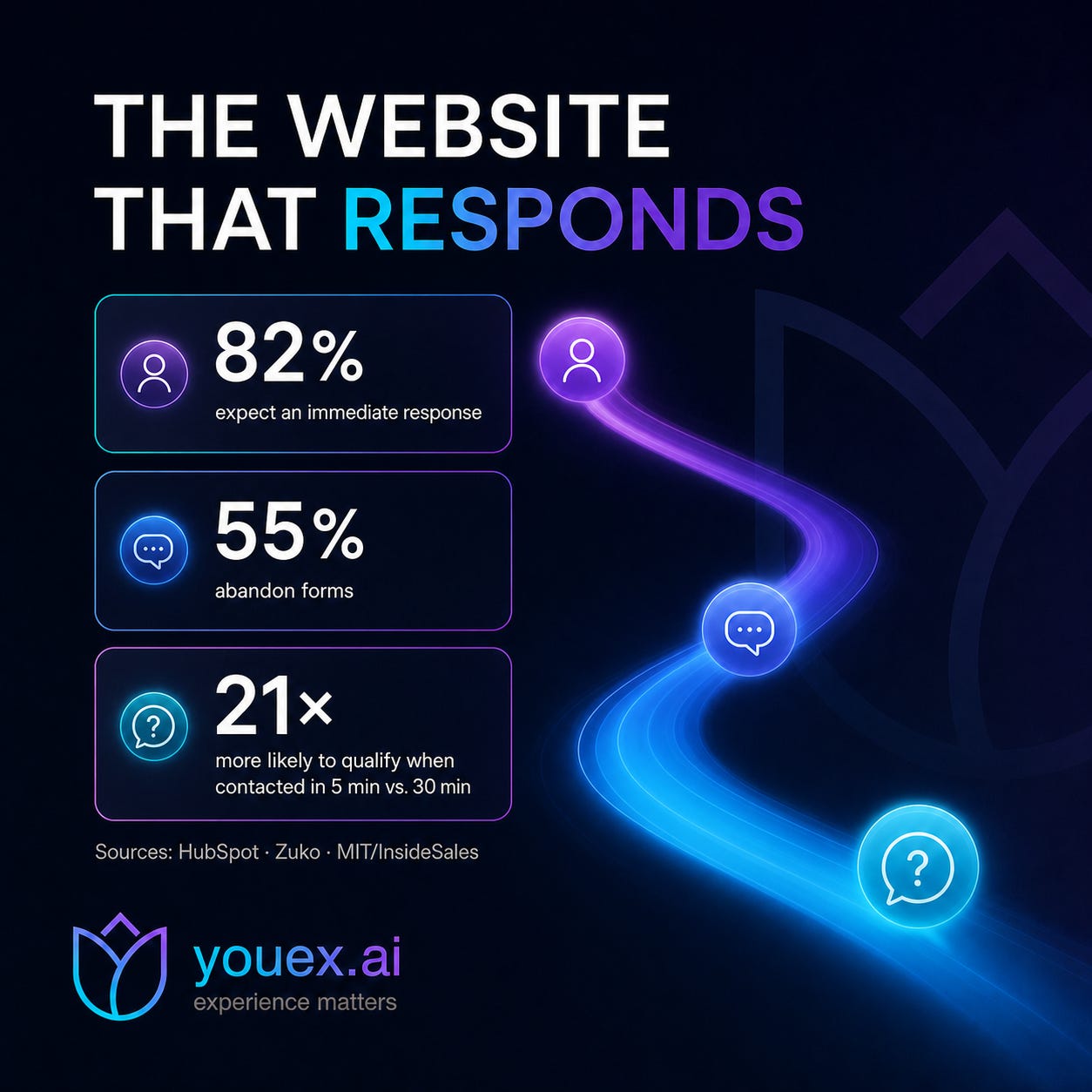
Yes. In HubSpot’s live-chat research, 82% of respondents said an immediate response to a marketing or sales question was important or very important. The research defines “immediate” as ten minutes or less. A website that can answer a real question in the moment is not simply offering better service—it is removing friction at a high-intent moment. HubSpot, How Live Chat Exposes a Fatal Flaw in Your Go-to-Market
Are forms creating too much friction?
Yes. Zuko’s aggregated form-analytics benchmark found that 55% of visitors who start a form don’t complete it. Abandonment changes with traffic source, device, form length, and the value a visitor expects in return. But asking for every detail before providing help can cost engagement. Zuko, 25 Conversion Rate Statistics You Need
Does AI chat need a clear route to a human?
Absolutely. Salesforce found that 56% of consumers are more likely to use an AI agent if there is a clear escalation path to a person. The best conversational experiences make this visible from the outset: be transparent about AI, ground answers in approved content, and make human help easy to reach. Salesforce, State of the Connected Customer, 7th Edition
Does live chat improve conversion?
It can, but results depend on the implementation. Invesp reports that adding live chat can increase conversion by 20% and that chat participants are 2.8× more likely to convert. Invesp, The Importance of Live Chat Customer Support
How much does speed-to-lead matter?
A great deal. The MIT/InsideSales Lead Response Management Study found that firms contacting a lead within five minutes were 21× more likely to qualify that lead than firms waiting 30 minutes. MIT/InsideSales Lead Response Management Study (archived PDF)
Harvard Business Review reached a similar conclusion: companies responding within an hour were nearly 7× more likely to qualify a lead than companies that waited one hour longer. Harvard Business Review, The Short Life of Online Sales Leads
Is AI Chat relevant for professional services?
Yes. Clio’s 2024 secret-shopper study found that only 40% of law firms answered prospective-client calls, and 48% were effectively unreachable by phone. A website conversation should therefore do more than collect contact information: it can provide useful guidance, qualify the inquiry, and route the resulting context to the right owner. Clio, 2024 Legal Trends Report
Why is a website conversation better than adding another sales tool?
It should simplify the work. Salesforce reports that sales teams use an average of 10 sales productivity tools, and 66% of reps surveyed felt overwhelmed by the number of tools. The goal is to pass a helpful lead record into the systems the team already uses. Salesforce, Sales Productivity and Pitfalls
Salesforce’s 2022 State of Sales research also found that reps spent only 28% of their week actually selling. Automating routine capture, research, routing, and first follow-up gives people more time for conversations that require judgment. Salesforce, State of Sales research announcement
What should a conversational website do?
It should make the next useful interaction easy:
Start with a question that fits the page. Help a visitor compare plans, understand pricing, find the right advisor, or locate a resource.
Provide value before requesting details. Ask progressively for only the context needed to recommend the next step.
Keep a human route visible. Let visitors choose a person whenever they need one.
Route the complete context immediately. Send the conversation summary, intent, and requested action to the appropriate owner.
Measure the journey, not just form fills. Track visibility, engagement, questions answered, qualification, handoff, meeting booked, and response time.
Here’s the takeaway: don’t make people wait, hunt, or repeat themselves. Answer questions while visitor interest is high, make the right next step easy, and carry the context forward to the person best equipped to help. AI doesn’t replace human expertise. It frames how you make that expertise available at the moment it matters most.