November 14, 2026
Inside the FAA SMART Air Traffic Planning System: a Technical Overview
The FAA’s new SMART system brings predictive computing to a practical problem: too many flights trying to use the same constrained airspace at the same time. Its purpose is to help traffic managers anticipate congestion and evaluate changes to routes and departure times before delays spread through the network.
For technologists, the interesting story is how the system combines operational data, forecasts, simulation, and human decisions. The published FAA requirements make that engineering problem unusually concrete.
What does SMART actually do?
SMART stands for Strategic Management of Airspace, Routes, and Trajectories. It supports the FAA’s broader Flow Management Data and Services program, or FMDS, which is replacing the legacy Traffic Flow Management System. 16
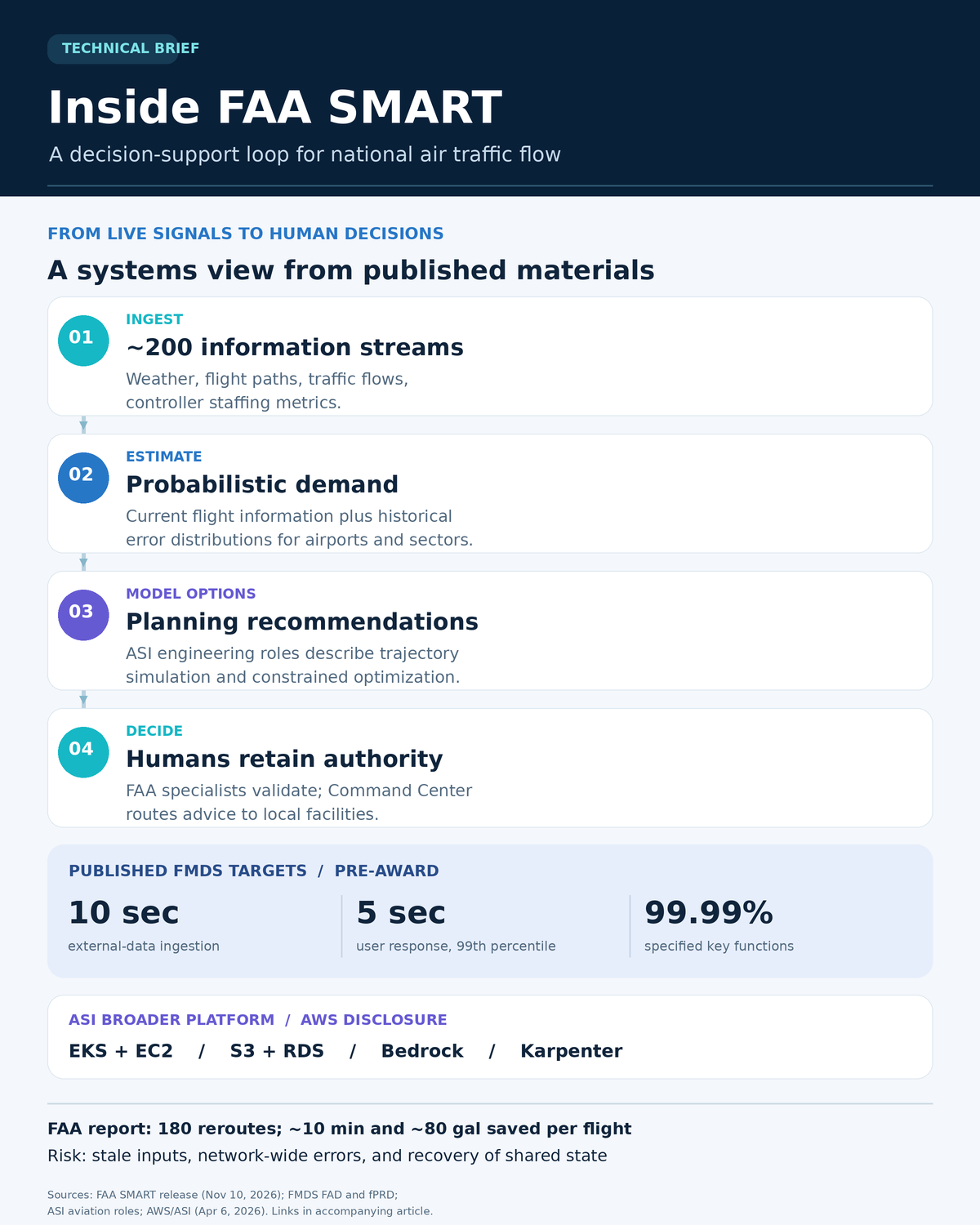
The FAA began limited SMART operations around Washington, D.C., on September 21. On November 10, it announced expansion to airspace served by all 22 centers. The agency describes a cloud-based platform bringing together roughly 200 streams of information, including weather, flight paths, traffic flows, and controller staffing metrics. 2
The operational workflow preserves human authority. FAA specialists analyze and validate SMART information, then send recommendations to the Air Traffic Control System Command Center in Warrenton, Virginia. The Command Center routes those recommendations to local facilities for consideration. Controllers remain responsible for keeping aircraft safely separated. 1 2
Air Space Intelligence, or ASI, is the prime contractor. The federal award record lists a potential value of $875.95 million, including options, and a term running from June 2026 to June 2038. That figure covers the broader FMDS work; the record retrieved for this article showed $23.34 million obligated. 3
How does the planning architecture work?
The FAA’s FMDS concept describes a microservices architecture, with individual functions drawing on shared services such as flight-data access. It favors centralized processing and a smaller hardware footprint at remote facilities. Its external integration landscape includes FAA information-sharing services, communications networks, and en route, terminal, and oceanic automation systems. 4
The FY2027 budget justification makes the intended enterprise role clearer. Its architecture diagram places shared Flight Object and Flow Object data services between FMDS and other systems, including Time Based Flow Management, Terminal Flight Data Manager, and separation automation. It describes consolidating more than 40 legacy applications and supporting standardized flight and flow information exchanges. 5
A useful way to read that design is as a shared operational model: flights, trajectories, constraints, and capacity estimates become inputs that multiple applications can use consistently. That consistency matters because optimizing one flight can change the conditions faced by many others.
How are predictions simulated and optimized?
The FAA’s functional analysis describes a specific demand-prediction method. It first determines demand from current flight information, then computes smoothing coefficients from historical error distributions, and uses those coefficients to produce probabilistic demand estimates for airports, sectors, and fixes. That adds a statistical representation of uncertainty to the planned flight picture. 6
ASI’s aviation engineering descriptions add detail about its simulation and optimization work. The simulation role covers discrete-time, physics-based models of aircraft trajectories, weather, controller behavior, and pilot behavior, plus Monte Carlo analysis to validate and tune algorithms. Monte Carlo methods evaluate many sampled scenarios, helping engineers examine how outcomes vary as conditions change. 7
The optimization role calls for experience with linear programming, mixed-integer linear programming, constraint satisfaction, and greedy algorithms. These methods search for workable choices within a set of limits, such as available capacity, route restrictions, and competing demands. The postings describe the company’s engineering work and desired expertise, rather than specifying every algorithm in a deployed product. 8
Together, these functions explain the computational problem. Prediction estimates what is likely to happen. Simulation explores how conditions and interventions could develop. Optimization evaluates which available changes best satisfy operational objectives.
What cloud and software stack has been disclosed?
AWS and ASI describe the vendor’s broader platform using Amazon EKS and EC2 for compute, S3 for storage, RDS for databases, and Amazon Bedrock for custom-model training, refinement, and inference. The architecture uses stateless applications, multiple Availability Zones, and Karpenter for automated compute scaling. The disclosure also describes private VPC subnets, encryption, least-privilege access, and administrative multifactor authentication. 9
The same account describes model workloads such as predicting taxi times, anticipating traffic around convective weather, and optimizing routes. It reports a platform lookahead of eight to twelve hours, with decision support updated every few minutes. These are disclosures about ASI’s platform, rather than SMART service-level guarantees. 9
ASI’s aviation software posting identifies Rust and Python, Kubernetes, Terraform, Helm, Grafana, Prometheus, PubSub, and Dataflow. Its aviation ML posting names Apache Beam and MLflow, along with production ML frameworks, experiment tracking, data versioning, and model governance. 10 15
That combination points to several distinct engineering workloads: processing changing operational data, running computational models, serving applications, and managing the lifecycle of trained models. Each has different scaling and reliability requirements.
What performance and reliability does the FAA require?
The FAA’s pre-award FMDS requirements provide measurable design targets. They describe the intended replacement system and predate ASI’s June 2026 award. 11
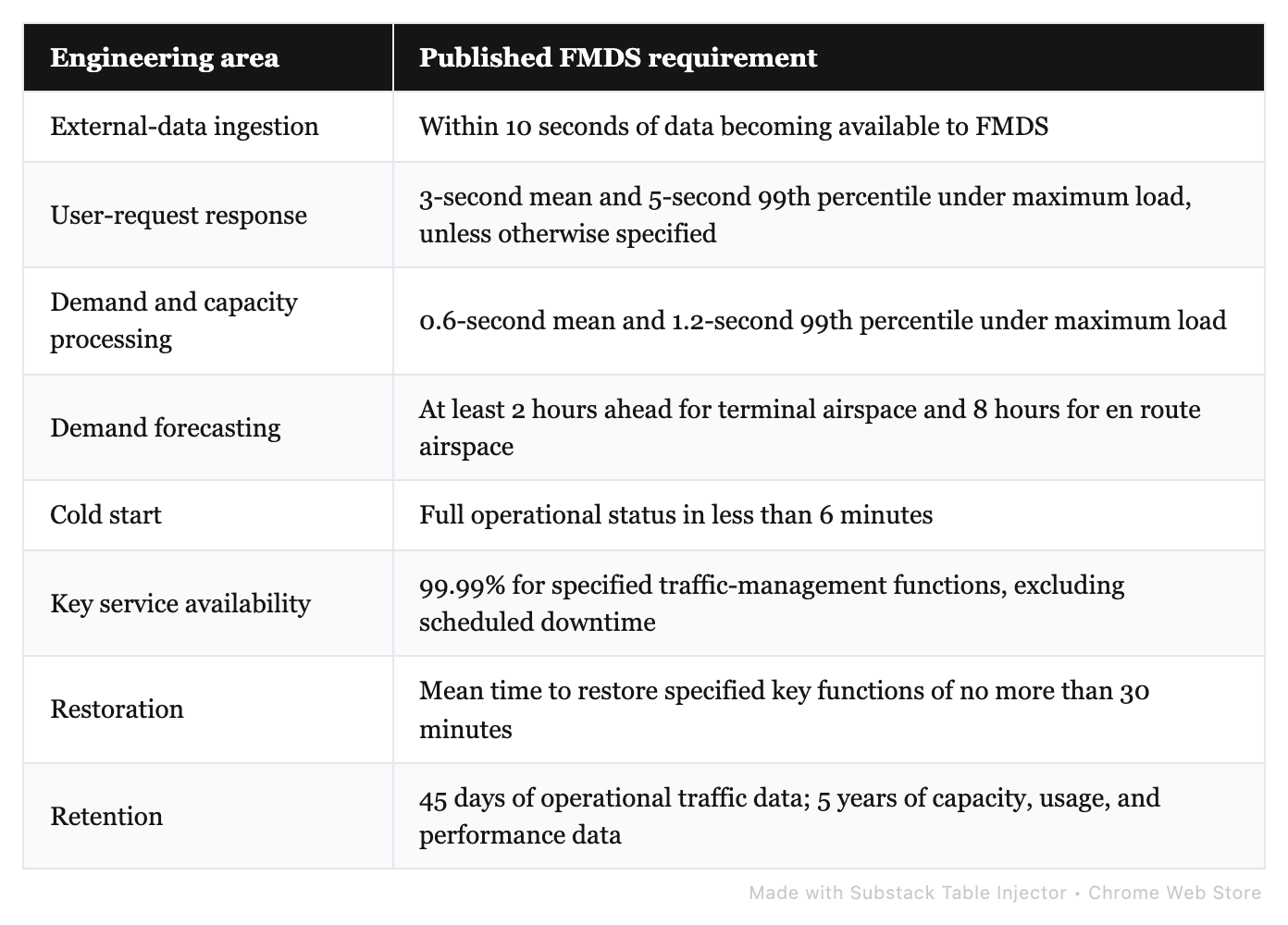
The requirements also call for redundant components, automatic switchover, data lineage, and procedures for disconnecting feeds when integrity is lost. 11
For an engineering team, those targets translate into responsibilities beyond keeping servers online. A service must process information on time, preserve its meaning, and recover with a coherent view of operations.
What benefits have been reported?
The immediate opportunity is to use available airspace more efficiently. Earlier awareness of weather and capacity constraints gives traffic managers more time to adjust demand, consider alternate routes, and prevent local congestion from spreading. The FAA also identifies fewer delays and cancellations, lower fuel consumption, and better predictability as intended benefits. 1
On November 10, the FAA reported that SMART had helped reroute 180 flights, saving an average of 10 minutes and almost 80 gallons of fuel per flight. Those figures describe the rerouted flights reported by the agency, rather than an average improvement across all flights. 2
There is commercial operating experience behind ASI’s technology. In its August 2024 Flyways renewal announcement, Alaska Airlines reported more than 1.2 million gallons of fuel saved in the preceding year. It also reported 3–5% fuel savings and emissions reductions on flights longer than four hours. Those are airline-reported results for Flyways, a related commercial product. 12
Where are the engineering risks?
The principal risks follow from the system’s job: turning changing, imperfect information into recommendations that affect a shared network.
Data freshness and consistency. A route recommendation can become unsuitable if weather, runway configuration, or sector capacity changes. The FMDS concept explicitly describes warning operators when a weather feed fails and marking displayed weather as potentially stale. This makes data health part of the operating interface. 4
Errors that spread across the network. A common forecast helps facilities coordinate, but a common error can also influence several decisions at once. Simulation quality, uncertainty estimates, and downstream capacity checks matter because an improvement for one flight can shift a problem elsewhere.
Recovery of operational state. Restarting a service is only part of recovering a planning system. Flight identities, timestamps, restrictions, configuration, and model versions must agree. The FAA’s redundancy, lineage, and synchronization requirements address elements of this problem. 11
Human reliance on automated recommendations. Human review is most useful when an operator can understand the recommendation, recognize stale inputs, and judge its local consequences. During a disruption, the interface and review workload become part of the safety system.
Change management. Software releases and model updates can alter behavior even when the infrastructure remains healthy. Testing needs to cover both computational accuracy and operational consequences. The FMDS statement of objectives requires design to RTCA DO-278A Assurance Level 5, while the requirements document specifies safety assessments and a Program Safety Plan. 14 11
What happened during yesterday’s nationwide ground stop?
On November 13, the FAA imposed a nationwide ground stop after communications problems affected air traffic control facilities. In its account that evening, DOT attributed the disruption to intermittent telecommunications outages and legacy equipment. Secretary Sean Duffy said SMART was not involved, describing it as providing advice for humans to accept or reject. DOT reported that the airspace reopened at 8:15 p.m. Eastern. 13
The incident illustrates a basic dependency: predictive planning software still relies on dependable communications and operational infrastructure.
SMART brings together a set of demanding technical disciplines: operational data integration, statistical prediction, physical simulation, constrained optimization, and resilient software delivery. Its potential value comes from helping people make better coordinated decisions early enough to change the outcome.
The engineering standard is equally practical: timely information, useful recommendations, controlled changes, and reliable recovery when part of the system fails.
Where can readers verify the details?
[1] FAA — SMART launch announcement. September 21, 2026.
[2] FAA — SMART nationwide expansion and early results. November 10, 2026.
[3] USAspending — Contract 693KA726C00064. Award signed June 23, 2026; record retrieved November 14, 2026.
[4] FAA — FMDS Concept of Operations. February 2022; §§4.4–4.5, printed pp.61–64; §5.5, pp.75–76. Published in the September 2025 acquisition package.
[5] FAA — FY2027 Congressional Budget Justification. Facilities & Equipment pp.43–44, PDF pp.153–154, including the FMDS integration diagram.
[6] FAA — FMDS Functional Analysis Document v2.03. October 4, 2024; §3.1.1.2.2, printed pp.35–36, PDF pp.38–39.
[7] ASI — Simulation Software Engineer Aviation. Employer description of simulation work and engineering skills; accessed November 14, 2026.
[8] ASI — Optimization Software Engineer Aviation. Employer description of operations-research work and engineering skills; accessed November 14, 2026.
[9] AWS and ASI — ASI and AWS see the future of complex global operations. April 6, 2026; infrastructure, resilience, security, and model workloads.
[10] ASI — Aviation engineering disclosures. Software Engineer role; accessed November 14, 2026.
[11] FAA — FMDS Final Program Requirements Document v1.3. February 18, 2025; published in September 2025. §2.2 p.11; §§3.2–3.4 pp.41–48; §5.2 pp.62–65.
[12] Alaska Airlines — Flyways partnership renewal and operational results. August 9, 2024; airline-reported fuel and routing results.
[13] DOT — Ground stop explanation and statement about SMART. November 13, 2026; official account of the outage and restoration.
[14] FAA — FMDS Statement of Objectives. September 2025; §4.1, PDF p.7, RTCA DO-278A Assurance Level 5.
[15] ASI — Machine Learning Engineer Aviation. Employer description of production ML tooling and skills; accessed November 14, 2026.
[16] FAA — Flow Management Data and Services. Official program description of the TFMS replacement and its intended capabilities; accessed November 14, 2026.